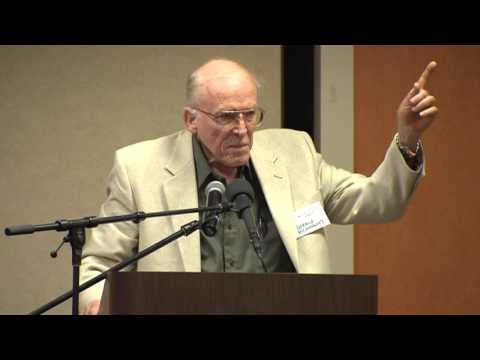
Introduction by Clayton Ogilvie
Dr. Gerald D. McKnight (October 12, 1932 – January 30, 2021) was a professor, a mentor and a friend to me. I met him when I attended a Fall 1993 seminar he was giving at Hood College that was part of his class called “The Politics of Assassination.” At the end of the class that featured Harold Weisberg as a guest speaker, Professor McKnight indicated that Harold was a neighbor and a generous friend who shared access to his basement full of government records on the Kennedy and King assassinations which were the basis for the class.
In the months succeeding that seminar, I would visit Professor McKnight at his home and develop a close friendship with both Professor McKnight, his wife Barbara, and Harold Weisberg. I would transport both men to the National Archives at College Park for document reviews and the examination of Zapruder film slides.
In late 2001, I watched Harold and Gerry’s friendship slowly deteriorate as Harold made increasing demands on Gerry’s time while he was preparing his book, “Breach of Trust.” Harold believed Gerry owed him for the access he had provided to the JFK assassination materials in his basement, which formed the basis for the book. In the weeks before Harold’s death, his demands became intolerable, and the friendship fractured, leaving me as a go-between for both men. By February, 2002 they met one last time at Harold’s wake and burial plot. Though their friendship foundered in life, they kept a common goal: to create a record for history.
Following is Alan Dale’s previously unpublished 2014 interview with Dr. McKnight. The topic of their conversation was Harold Weisberg.
Audio: Alan Dale with Professor Gerald D. McKnight, March, 2014
Transcript
Gerald D. McKnight Speaks with Alan Dale about Harold Weisberg – 2014
Alan Dale
By 1965, a man named Harold Weisberg had retired after a career as an investigator for a Senate Subcommittee on Civil Liberties, an analyst for the Office of Strategic Services in World War II, a dedicated patriot whose parents had been Jewish immigrants from Russia. Born in 1914, Mr. Weisberg became a chicken farmer in Maryland. His first book, Whitewash, after a careful analysis of the evidence presented in the Warren Commission’s report, criticized the conclusions and undermined the single-bullet theory. Someone who knew him well is the Distinguished Professor Emeritus of History at Hood College, author of Breach of Trust, How the Warren Commission Failed the Nation and Why. which was updated in a 2013 edition.
It’s my pleasure to welcome back to our program Gerald D. McKnight. Professor, thank you for being with us.
Gerald D. McKnight
My pleasure.
Alan Dale
Harold Weisberg seems to me, always has seemed to me, to be quite a character, in addition to being someone who obviously was profoundly impacted not only by President Kennedy’s assassination, but perhaps in particular by how the United States represented that crime. By 2001, your relationship had changed with Mr. Weisberg. Can you tell me a little bit about that stage?
Gerald D. McKnight
Yeah, I’ll say a little bit about it. Clay Ogilvie had put all of his material on… It’s on a computer. You can get it on a computer. And so it’s an enormous, enormous collection of materials you can all imagine. And on there, for example, but it will not be accessible to anybody except me. When he, under the category of subject names, he will have my name there, but it’s restricted. You can’t get onto it. And the reason is because there must be seven or eight letters that Harold wrote me in 2000. It was 2001. The situation, as I recall it was that he was going into the hospital and he said to me that he wanted all of his books taken out of their home, down in Shookstown, off Shookstown, really.
Alan Dale
In Frederick, Maryland.
Gerald D. McKnight
In Frederick, Maryland. And he wanted them over at Hood College. So given that directive… I was put in a position of going ahead and following through on that request.
Well, actually, before I had a chance to do that, my good friend Clay, really one of my best friends, Clay Ogilvie, who knew Harold and at that time was very closely aligned with him. So, he moved the book over to Hood College. So, when Harold came back from the hospital, I don’t know what they did to him over there, but when he came back from the hospital, all his books were gone. And so, then he called me up and then he excoriates me in terms of how dare I must have known that he was that he was an extremist when he gave me or when he gave me directions to do that. And so, I never got a chance to tell him I didn’t do that. I didn’t move the books. Clay moved the books. I didn’t get into that at all. And so, then he began to pelt me with these letters about how stupid I was and what was the other thing. His favorite term was sick ego. I mean, when he was attacking people, that was one of his favorite terms. You have a sick ego. So anyway, here we were. I was four minutes away from Harold’s house. And at that point, I just said, that’s a relation that’s cut. I’m not going to put up with this. I don’t need it. And so that was the result of a relationship that we had.
Alan Dale
Going back to the 1970s …
Gerald D. McKnight
Yes, okay. So that’s over 30, that’s about 30 years, right.
Alan Dale
So, this last passage this last passage in your story was 2001 is that correct 2001 yeah 2001 is when this when this crisis this uh this crisis occurred and he passed away in February i think of 2002.
Gerald D. McKnight
You got it. Right, so it was right at the end. It was February 2002,
Alan Dale
Yes. Well, so back in the 70s…
Gerald D. McKnight
Yeah, well, back in the 70s, you know, here I was, a young guy. A young guy was, you know, I had seen something. I had been to Korea. I had seen the war. It was part of the graves registration. Went out, collected bodies, which was sort of eye-opening.
Alan Dale
Undoubtedly.
Gerald D. McKnight
I mean, you know, that was that stage of the war, 50, let me see, that was 50, 51, 52, when the Chinese approach over there were mass, mass attacks.
Alan Dale
Yes.
Gerald D. McKnight
And even mass attacks where you had a lot of these Chinese infantrymen were thrown into the mass attacks. They didn’t have enough weapons to equip them. And so. They were to hang around or move with the troops, but to wait till somebody up front with a rifle was shot and put out of commission, then they would pick up the rifle and go.
Alan Dale
Yeah, that’s astonishing.
Gerald D. McKnight
So, when this kind of, after this, then there would be a truce after the engagement was over, maybe there’d be a day or maybe more, whatever it might have been. And then both sides would come in. We would come in. I was with 8th Army. And the guys I was with, all of them, virtually all of them were Marines from World War II. They had seen all the shit. I mean, they had seen everything. They had seen it all. Nothing surprised them. I’m 18. These guys are 28 going on 107. I mean, you know.
They had been through Iwo Jima, Okinawa, I mean, they had the Aleutians, they had been, they had, all these guys had seen, one of them had seen something or other, Guadalcanal, the whole business, and the stories they could tell. I mean, and they were what, 28, 29? I mean, there’s nothing, there was nothing they didn’t know about combat and had seen. So, so anyway. I don’t know how I got into that, but… It’s fascinating. Then I went off to college, and I had some economic support from service money.
Alan Dale
And you end up in Frederick, that’s for sure.
Gerald D. McKnight
I ended up in Frederick, yes. I ended up in Frederick, and teaching at Hood College, happy as hell to be there. And this was 1970, it was an all-women’s school at that time, and these women were terrific. writers could be. Terrific.
I mean, it’s co-ed now. It has to be. You can’t be a women’s college anymore and survive economically. And Hood College is marvelous. I mean, the physical plant is terrific and everything. So anyway, so here I was. And so I got, I’m not sure how I found out that Harold Weisberg was a neighbor of mine. But when I did, the head of the political history department was a woman by the name of Virginia Lewis. She looked like the wrath of God. I mean, she was this huge woman.
Alan Dale
Oh, yeah, 6’3″, or something like that.
Gerald D. McKnight
Oh, yeah. She was built like this New York Giants linebacker.
Alan Dale
I think one of the two of us said that she resembled the Secret Service follow-up car, they called the Queen Mary
Gerald D. McKnight
(Laughs) Right! Yeah!
Alan Dale
But she was nice and she was encouraging she was she was a Kennedy i mean she was a long-time Democrat and she was a Kennedy loyalist who would get into rhapsody about JFK, so when she found out that I had made this connection with Weisberg, she said, well, wait a minute. And so, from that point on, she suggested to me that, would you like to put a course together on the Kennedy assassination?
Alan Dale
But you don’t exactly remember how the initial contact with Harold Weisberg took place?
Gerald D. McKnight
No, I don’t, other than somebody… I can’t remember it now. I couldn’t.
Alan Dale
So, was he familiar? Had you, for instance, encountered Whitewash or Whitewash 2, which came out, I think, a year after the original?
Gerald D. McKnight
I probably was familiar with Whitewash 1. I was familiar with that. And I was familiar with Harold in terms of the names that you associated. with those who were engaged in questioning the official story of Dallas.
Alan Dale
Of course, yeah, relatively small community at that point.
Gerald D. McKnight
Yes, I would say a relatively small community.
Alan Dale
Forceful that’s a good word. I wonder how many people are aware that Harold Weisberg actually moved to New Orleans so he could work with Jim Garrison during, I guess, 1960… certainly ’68.
Gerald D. McKnight
New Orleans, okay. I didn’t, If, well, he did do a book Oswald in New Orleans he did i think it was a title one of the books he did Oswald in New Orleans. I had forgotten about that; I didn’t know about that and he had actually physically removed himself i don’t know i don’t know who ran the household how that worked i don’t know but he was down there in some capacity uh acting as an investigator for uh Jim Garrison yeah i’m sure you’re right about that uh although i i had forgotten about it i mean maybe something i guess i had totally forgotten about but anyway so So that’s what started the relationship. I got a class going on the Kennedy… It was more than the Kennedy. Let me see, we were dealing with, well, I remember now, we were dealing with the Kennedy assassination and we were dealing with the King assassination.
Alan Dale
Of course.
Gerald D. McKnight
In the same course. And I had a big manual I put together, the documents and questions, and it went really well, largely because the students grabbed onto it and were hungry for it. I think this was entirely a new kind of course material. It’s so immediate and so important, and these young women at that time, they were all women. Well, men could go to class here, but they were not residential.
Alan Dale
So if I understand correctly, then he became somebody who was…
Gerald D. McKnight
He became a source.
Alan Dale
He would show up every semester. Right. So he was your mentor in a way with regard to…
Gerald D. McKnight
Oh, absolutely. Oh, absolutely. Well, look, it isn’t just mentoring. And I think you understand and would know it, but maybe it would be helpful for those who are going to track into this program. Is that his basement, he had 60, I think it was over 64 drawer file cabinets down there. And he had material on that he went ahead and got under Freedom of Information Act and other stuff that he had to pay for. He had those cabinets were full, all four drawers right on back. And it was both King and JFK material. And the point about it was that that material in his basement was available to anybody who had an interest.
And the way it worked was that person came to Harold’s house, introduced themselves, who probably already had over the phone, was interested in taking a look at this, that, the other. And he said, Harold said, there’s the torch of the stairs to the basement, which is the finished basement. And he said, check the files out. Bring them on upstairs, those things that you want. There is my copier. You can use my copier.
Alan Dale
Oh, wow.
Gerald D. McKnight
What a dream situation. Who is this man? Is this the same guy that I had a sick ego and was hopelessly retarded? Whatever the hell it was he said. He went on and on. Eight or nine letters. I forget what the hell it was. I mean, they’re on the… They’re in the computer here, but under my name, it’s restricted. You can’t get into it. And I don’t know even why the hell Clay left them on there. But there it is. I guess it’s all part of the record. But anyway, that in itself, I think, elevated him in my mind anyway, because that wasn’t totally unusual, I guess, in terms of sharing. But in this way. in terms of having free and unfettered, unpoliced access to his records. Now, I have to tell you that ultimately, a thing like this, when you have an open-door policy like that, you’re going to end up getting some shithead, some crap, crappy person who is going to go down there and is going to steal records. And ironically, in this particular case, I’m trying to think of the source of this. Somebody living in Baltimore had a Baltimore cop, whose name I cannot remember, come to Harold’s place and get records. But in terms of sometimes in getting the records, he also took records that he didn’t tell Harold about, and he stole them.
Alan Dale
Oh, I didn’t know that.
Gerald D. McKnight
He stole them and he turned them over to this individual up in Baltimore. I wish I could remember his name. It would give more punch to the argument here or to the presentation. And so this dishonest SOB was playing the role of an intermediary here. He may have even sold them to the guy in Baltimore. Don’t know. The guy in Baltimore did write on the Kennedy case. So I’m sorry, I cannot remember his name. But but and I don’t know if that happened more than just in this particular case with other people. But that’s that’s that this was a total open door approach down there.
And so, you know, given the human condition and what human beings are like, there’s going to be some SOB who’s going to take advantage of it. There may have been more than one, but I do remember that. I do remember that, and I can’t remember the name of either of the cops. or the one that he was in league with, I cannot recall.
Alan Dale
But at least your experience seems to be one where he was astonishingly generous, and I’ve heard that from others. Oh, absolutely.
Gerald D. McKnight
Oh, sure. Oh, sure. What the hell? I mean, right now, well, of course, he’s gone now, and has been gone. But I’m just trying to remember, while the… While he was alive and while I was teaching that course, Virginia Lewis also sat in on it and did some teaching, although being department chair, she didn’t have all that much time. But she supported the whole project from beginning to end, and I stayed with it. Even after she left and retired, we had a new chair in the department. And by that time I was established and, you know, and so and so there’s some attention given to it locally. I mean, you know, we had people come in. We had lectures, that kind of thing.
From just simply a course, it now grew to a kind of a little, what shall I call it, I guess, a small little ripple on the pond.
Alan Dale
Well, I think eventually it grew into Breach of Trust, didn’t it?
Gerald D. McKnight
Oh, absolutely. Well, my Breach of Trust and Dave Wrone’s book.
Alan Dale
Oh, that’s right. Dave Wrone, of course.
Gerald D. McKnight
Dave Wrone put out a book.
Alan Dale
I’ll come up with it. Here’s something that I’ve always… wondered my perception I haven’t studied Mr. Weisberg with in any way other than superficially everybody’s aware of who he is I think everybody or at least a lot of people may have the perspective or the sense that he was a bit of a curmudgeon of some kind that he was kind of possibly hard-headed or intolerant of certain things certain people and that’s perfectly fine especially because there are plenty of things that are properly one should be properly intolerant of is it fair to say that he seemed that his motivation for for devoting his life the the period of his retirement uh up until the very end of his life to the subject of President Kennedy’s assassination, mainly because he seemed so incensed that the Warren Commission report itself seemed so flawed, so inadequate? Or do you think… Well, go ahead. No, you go ahead. no you go you go ahead yes go ahead i was just going to say uh is it something that was he offended do you think because um of the the uniqueness of his story his parents Russian uh immigrants and uh his love of the country and the idea that that you know the assassination itself of course is an abomination and obviously significant consequential event on the world stage, but not until the publication of the Warren Commission report does he seem to be truly incensed that what is clearly depictable as a political event is represented in the pages of the Warren Commission report as something other than that.
Gerald D. McKnight
And the title, Whitewash. I mean, this is what the Warren Commission was.
Alan Dale
That’s his first title, right. It was a whitewash.
Gerald D. McKnight
Of course. It was a whitewash. There’s nothing incorrect about that.
Alan Dale
Strong language. Strong language. Oh, yes.
Gerald D. McKnight
Strong language. But that’s a fact. Those are the facts that I think others who would come after him would, who picked up the cudgels and moved in the same direction, said, yeah, of course. There’s nothing really to believe in the Warren Commission. And that was from day one. Well, not day one. It certainly was from day two that you can see that in the Freedom of Information Act. Of course, if we didn’t have that, of course, we probably maybe would still suck your thumbs. And abiding by what was the official solution here, which was a solution to get the nation out from under this political disaster. And, of course, the removal of Kennedy.
I mean, in a way, if you want to try to. I think, put a peg in the board and say, here is the beginning of the decline of the United States, where we find ourselves today. We find ourselves a nation today in which the economy is run for the benefit of the upper 2%. We have a foreign policy that we have, what, 700, 800 bases overseas. The kind of money we put out for this empire of bases that we have is astonishing. It’s over a trillion dollars a year, and God knows how much beyond that. It is killing the economy. Well, some economists look at this and simply say, give it another 10 or 15 years, and the nation will be bankrupt.
The economy will be in the toilet. unless we can disestablish the empire. I don’t see any indication of that now, do you? I don’t see that at all.
Alan Dale
No, I’m with you.
Gerald D. McKnight
But with Kennedy, you know, there would have been no Vietnam involvement, okay? It would have been. I mean, at least that we know. I mean, General de Gaulle and MacArthur said, don’t get into Vietnam. It is not where you want to be. You have no business going over there. This is a struggle between the Vietnamese and China. As Ho Chi Minh said, we’re tired of eating Chinese shit for the last thousand years. We want to get out from under. You know, and then all of a sudden Johnson brings us into this thing. Well, of course, Johnson is part of the is part of the conspiracy. You know, he’s he’s tied to this whole thing. He and elements of the CIA, probably the secret government over here.
You know, Lyndon Lyndon was not it was not innocent in this thing. And we do know that in 64, he would not be on the ticket. They were going to drop him. No reason why they shouldn’t. He supported nothing in the Kennedy first administration. Everything that Kennedy came down with, he opposed, and particularly the Civil Rights Act, which, of course, then he signed on to, because then he signed on to it.
Alan Dale
He gets the credit for it.
Gerald D. McKnight
But he has a record. I don’t know.
Alan Dale
Oh, I hear you.
Gerald D. McKnight
Yeah, well, yeah. And I mean, in terms of, you know, a record in terms of Phil, Phil Nelson has done one book and is now have another one coming out on the Johnson administration. And he has he has nailed him down as as as as running. in addition to everything else, as running his own private mafia down there. I think he’s listed about 10 or 11 people that Lyndon Johnson had removed. One of them was his own sister.
Alan Dale
It’s quite a story, isn’t it?
Gerald D. McKnight
Yeah, it’s a story that nobody hasn’t been told and hasn’t been appreciated or redowned back into historic interpretation of what… Happened in Dallas, what it meant, what it meant, long term.
Alan Dale
With regard to your personal relationship with Harold Weisberg, I realize that he was of an older generation, and he was somebody who was, you know… Somebody that was sort of, would you say, iconoclastic in his own way, that he was not your typical sort of profile of somebody that you’d look to as a…
Gerald D. McKnight
Well, not for a chicken farmer. Yeah. What do you expect from a chicken farmer?
Alan Dale
Well, yeah, how many chicken farmers?
Gerald D. McKnight
He had been in military intelligence World War Two.
Alan Dale
I know, I know.
Gerald D. McKnight
There’s that backdrop, exactly what all he did. I don’t know. And I don’t know whether he got on a soapbox and preached about that. I mean, he was much more subtle. And also, I think, much more… what should I say, at rest with himself. And sometimes… Self-assured.
Alan Dale
Self-assured. Yeah. Oh, absolutely self-assured. Yes, that’s something you get from hearing him speak. The occasions where he was interviewed, you hear him speak, he seems so solidly grounded, you know, because he’s speaking authoritatively about things that he really seems to me… and you can correct me if I’m wrong, but he seemed to have been very cautious with regard to speculation, and he preferred, I believe, to concentrate on things about which there could be an analysis of records, and especially to compare or contrast with conclusions drawn from interpretations which arguably could not be substantiated in the in the official record.
So one of the questions that I have is, did he ever speculate with you, or did you ever ask him, where do you think this leads? Who do you think was actually responsible for the assassination? Because I’m not aware of any place where he said, I think the CIA did it, or I think that it was, you know, a construct of some national security state. you know, collaboration with elements of the military-industrial complex or whatever. He seems to me to be more devoted to the details of what he could substantiate through the records.
Gerald D. McKnight
Well, I think that’s right. Although, you know, when you look back over this whole thing and… And I’m not going to be able to, certainly not going to be able to turn on all the lights on the board. But when you look back over what happened in Dallas and putting forward of Oswald as the, you know, by the second day, I mean by the 23rd, you know, Hoover writing to telephone conversation with Johnson saying, well. In terms of Oswald being the shooter, the evidence against him, in his own words, is not very, very strong. On the 24th, of course, once Oswald is gone, right away, we already have the case. The case is, as Clouseau would have said, the case is solved.
Alan Dale
Solved.
Gerald D. McKnight
It’s solved. Yeah, there we go. I mean, so the transition from this business of uncertainty. And it’s that quick. It is that quick. And it probably is even adumbrated in the 23rd, when Hoover writes to LBJ on this question. So, oh, yeah, I don’t think Hal had any questions, although the problem is trying to prove this. Any questions that elements involved in this in terms of government, in addition to the vice president, were certainly CIA people, military people, Curtis LeMay, for example. Not that Curtis will make anything to do with the planning of this sort of thing.
But Curtis LeMay, after, you know, Kennedy pulled back on the Cuban Missile Crisis and refused to turn this into an invasion, you know, Curtis LeMay was ready at that point to declare Kennedy unfit to be president of the United States. I mean, the hatred there and the fact that there was an opportunity to go in there and wipe out Castro and wipe out the Cubans and wipe out that issue. And Kennedy took another approach with Khrushchev. I mean, at least he could work with Khrushchev. He and Khrushchev were able to find some kind of common ground.
But the removal of, I think, of Kennedy here and elements of the military-industrial complex, I mean, I know those are semantically terms that are so wide and broad. Sure. But you’re talking about individuals. But what I’m just simply talking about is that an element in this government, a group in this government who found Kennedy’s approach to the Cold War not to be to their liking. Correct. They would have been more satisfied to do to Russia what we did to Japan unnecessarily, two bombs, two nuclear weapons. when Japan was all ready to surrender, ready to surrender. We do Nagasaki, Hiroshima, Nagasaki. And the purpose of that was what? Well, this was LeMay. The purpose of that in the military was what?
These two weapons were aimed at Russia. They weren’t aimed at Japan. Japan was already willing to sit down and sign the surrender. We wanted to give the Russians a message. And the message was those two cities. Yeah. we just think we evaporated we eliminated two cities to tell the Russians look you want you want to play with us well this is what you’re going to expect.
Alan Dale
Professor it’s time for us to take a brief intermission. We’re speaking with Professor Gerald D. McKnight and our topic today really is Harold Weisberg and it’s a pleasure to have this opportunity. We’ll be back in just a moment.
Boy, we’re really covering a lot more deeper stuff than I thought we would, you know,
Gerald D. McKnight
Because… Your system hasn’t caught on fire yet.
Alan Dale
It hasn’t blown up. I’m just embarrassed to tell you the truth because I’m not, I’m honestly not… that knowledgeable i’m not knowledgeable about Harold Weisberg I know who he is; I’ve already said about everything that my perception of him is about him being kind of hard-headed and all of that
Gerald D. McKnight
Well Alan, I’ll tell you what the other the other thing that needs at least to be said is that in terms of something that that you had elaborated or at least had moved in that direction to some degree. You do have the stuff that Weisberg wrote. I can’t remember all of the titles. Oh, yeah. Beginning with Whitewash, Whitewash 1, Whitewash 2, 3, 4. And then there are monographs that he post-mortemed, which, of course, is an extraordinary book. And then he wrote on King. Right, yeah. He wrote about King. And the other thing, unless you have access to his files, the other thing you don’t see are all of those almost book-length manuscripts that never got between hardcovers. Yeah.
Alan Dale
So he was prolific. He was really prolific.
Gerald D. McKnight
Oh, my God, prolific. You know, when you start stacking this stuff up, not only in terms of what appeared between covers that were purchasable, but what never did get to press. I just, one of the things I’m… thinking about hopefully if i live long enough and get i’m trying to do another book i don’t know what i’m going to call it maybe essays on the Kennedy assassination sure but uh uh but uh one of the key manuscripts will be called The Honorable Men it is a 400 and some 450 page manuscript on the Warren Commission people you know so and so that’s just one of them I don’t know how many manuscripts he has that have never gotten between hardcovers, okay?
But he spent time writing on them. I mean, just, and the purpose of it was not to project his view in terms of what this meant long-term in the future. but to simply reveal the corruption of this whole thing, how miserable it was and how self-defeating it was and how clear for anybody who had any integrity by looking at this thing and spending some time with it would see that it was, to see that it was. Nothing more than a great political lie. George Orwell would have come up with a wonderful title for all of this material.
Alan Dale
Yes, I hear you.
Gerald D. McKnight
As far as the Warren Commission.
Alan Dale
Well, you just used the key phrase about this being a political crime. I mean, there’s an excerpt that I can quote, not from memory, but I have it in front of me, from Whitewash, from his first. foray into his first publication on this subject, obviously exclusively or in particular related to the publication of the Warren Commission report and the necessary time that he took to read it. It wasn’t like, okay, well, here are his musings. He took a year to deal with the material. which was brand new and …
Gerald D. McKnight
26 volumes, 26 volumes.
Alan Dale
I know it … So here’s his quote, he says, “Assassination is a political crime even in rare remote cases where the assassin had no comprehensible political objectives the crimes had political consequences Whether it’s the head of state or a lesser official, the assassination has immediate political effects. With the head of state murdered, the changes in political structure and situation are more immediate and far-reaching. A policy change by the head of state has national and international implications, even when his successor follows the same basic policies.” Now, remember, this is ’65, so we don’t know then exactly what we know now about changes, especially with regard to foreign policy, understanding a little more deeply who JFK really and truly was. Weisberg continues by saying, “Nations and people are reluctant to believe that any among them is capable of the horrible crime of assassination. It’s less comfortable to believe the assassination. It’s less uncomfortable. to believe the assassin was insane, or at least unbalanced. Individually and nationally, thinking about assassinations turns toward the search for explanations more acceptable than the obvious. No one wants to believe a political murder was committed for personal gain, or that any segment of society is capable of such a monstrous deed for selfish ends. Shocking and paralyzing as assassination itself is to decent people, the traumatic feeling that somehow the nation itself is guilty may be even more stunning.”
This is a well-written assessment.
Gerald D. McKnight
Where did you find that, Alan?
Alan Dale
That’s actually a quote from Whitewash from 1965.
Gerald D. McKnight
From Whitewash 1? Is that right?
Alan Dale
Yeah.
Gerald D. McKnight
Well, I’m going to have to go back and find that.
Alan Dale
Well, I’ve got, very close to me right now, I’ve got Never Again, which I think he did kind of from, probably from the couple of years where the immediacy of Oliver Stone’s film was significant in terms of people discussing the film, obviously consequential politically because it resulted in the JFK Records Act, the ARRB, and all of that.
But in response, possibly, for all I know, to the material that was being discussed and that he was being asked about, relevant to Oliver Stone’s film, he came up with Never Again, the Government Conspiracy and the JFK Assassination, maybe in response to elements of the film with which he virulently disagreed and was upset about. His final book, Case Open, (I wonder what that relates to), Unanswered JFK Assassination Questions, that was 1996. And as far as I’m aware, those significant manuscripts to which you just alluded were never prepared for publication, so I think Case Open was his last book.
But my question is, is Clay Ogilvie interested or engaged or empowered to publish any of those materials, prepare them for publication, you know, posthumously?
Gerald D. McKnight
Oh, I think so. I would think so. There’s nobody around. Maybe Jim Lesar, but… I’m just thinking, Jim Lesar is a lawyer in Washington.
Alan Dale
Of course. He’s AARC.
Gerald D. McKnight
Yeah, yeah. I don’t know how responsible he is right now. I don’t know whether he would, I don’t know whether Harold assigned him any kind of control over these manuscripts. I don’t know that he has any control over the manuscripts. I mean, Clay is the one who has put all of Harold’s records online.
Alan Dale
And is that through Hood College?
Gerald D. McKnight
Yes. Okay, so that’s where. They are at Hood College, and they can be, I mean, I have them, Harold’s collection, I have everything that Clay has worked with. I have it on my computer.
Alan Dale
Yeah, boy, oh, boy, oh, boy.
Gerald D. McKnight
And so Clay really is the man, really, and should be the man in charge. He’s done more than anybody else. And Jim Lesar’s eyesight is failing, his health is failing. Their relationship remained, I think, remained positive right up to the end. And then, and… Since Jim was a lawyer, Harold used him, you know, in terms of his lawsuits, that’s for certain, yes. And they had, you know, they were a working team on that basis that Harold had to go to law to get documents from the government.
Alan Dale
Sure, well, we will make certain that there is… is a link, the proper link, to the Hood College page where the Harold Weisberg archives are available. But I hate to think that the future may offer no widespread distribution of any of the materials that remain unpublished. That would be unfortunate.
Gerald D. McKnight
Well, yes, and I’m not sure… I can’t answer the question right now whether, I mean, how available the Weisberg Archive is to, you know, somebody like you or, you know, somebody who’s interested, really interested, a student or somebody living in Frederick or somebody living in Saskatchewan or something. If they could call the could call the… the thing, if they could call up on the computer. I’m not sure they could.
Alan Dale
I think that quite a bit of it certainly is, but I’m not, we’ll investigate that. We’ll find out more. We’ll find out more.
Gerald D. McKnight
Well, I will also keep, I mean, I’m in touch with Clay. I’m in touch with Clay at least once a week.
Alan Dale
Okay.
Gerald D. McKnight
I mean, he’s sort of family, really.
Alan Dale
Well, then you could put me in touch with him, and I could ask him some of these questions, possibly. Would that be acceptable to you?
Gerald D. McKnight
Oh, I have no problem with that at all.
Alan Dale
Okay, that’s great. I’ll just make sure that there’s a link and that we know something about what is found at the Hood College link. But I’m not through with you. I’m not through with you. And I want to, and I realize I’m pushing it, but I want to be able to ask you a couple of quick things, if I may. And I’m so grateful to you. And I so enjoy the privilege of being able to speak with you. And I said that to you when we spoke the first time.
Gerald D. McKnight
You’re doing a good service. If you’re doing a good service, I try to help and support anybody.
Alan Dale
Well, God bless you. I appreciate it.
Gerald D. McKnight
That’s involved in this issue in an honest and authentic fashion.
Alan Dale
Well, I believe I understand that you…
Gerald D. McKnight
It’s a public responsibility. What the hell?
Alan Dale
That’s a great way to look at it, that we may all be in this separately, but it’s to our mutual advantage to assist each other along the way. Absolutely. And thank goodness Harold Weisberg was like that.
Gerald D. McKnight
What the hell has happened to this country that’s any worse than this, for God’s sake? That’s…
Alan Dale
Yeah, it makes you wonder, yeah, if this isn’t a primary subject in discourse, in discussion, on talk shows and everywhere else.
Gerald D. McKnight
But it’s not talked about anymore, I mean, in terms of the implication. And then, of course, you know, the issues we don’t talk, what are the issues we don’t talk about? I mean, global warming, my God, you know, how are you going to get Congress to talk about global warming? You know, half of these people ignore the fact or just simply dismiss it and say there’s no such thing. So you have global warming. You have our involvement overseas in terms of our empire of bases, which is a total waste of money. I mean, why not just put it in big canisters and burn it, for Christ’s sake? I mean, that’s better than keeping these 700 or 800 bases overseas.
You know, we don’t even talk about that at all. In terms of the money and the insane weapons program, the F-35, this airplane, that now is going to cost, if we ever get it offline, it’s going to cost $400 million a unit. Have you heard that? $400 million for a plane. And, of course, they will want to sell the Pentagon 250 of these things. There’s absolutely no use for them. There’s not another airplane in the sky that we need to deal with by having an F-35. But it’s good business.
Alan Dale
It sure is, and it makes me sick.
Gerald D. McKnight
Honestly.
Alan Dale
It makes me sick when I really feel in contrast to where we were more than 51 years ago with a president who had turned away and for all I know may never have been a fully committed cold warrior. And who understood things about supporting the nationalist movements in small countries around the world where there was a move for independence from colonial rule. And he naturally, I think, from the beginning was predisposed sympathetically towards those movements. And he was replaced by really the iron fist of global American corporatism.
Gerald D. McKnight
And the CIA…
Alan Dale
And the CIA implemented that policy around the world. How did our oil get underneath their sand? That’s part of it.
Gerald D. McKnight
Exactly.
Alan Dale
Anyway, you and I feel the same about that, but I want to ask you more specifically about your relationship with Harold Weisberg. I still want to know something about, did he ever say something? Did he introduce something to you? Is there a key moment that you remember? where he implied or he declared or he informed you of something that really opened your eyes about how much more there was to the story of the assassination than maybe even you had realized.
Gerald D. McKnight
It would be hard. I don’t think I can remember. a moment where, you know, all of a sudden a light bulb went on as a result of something that Harold said. That may have, that very well may have occurred. You know, my memory is not what it was at one time.
Alan Dale
Neither is mine.
Gerald D. McKnight
Well, I think I think Harold would say, look, the rubber’s hitting the road here. And what we’re what we’re talking about here, yes, is the removal of a president. It was a conspiracy within the government to get rid of him because of his policy lines, particularly in foreign policy and particularly relations with the Soviet Union to get rid of him and to move ahead. In our relations with the Soviet Union, which would be more hostile now, more sharp-edged, which provides the opportunity, provides the context for what? Military industrial response, right? You know, you’re going to spend money for a big army, an army you’re going to put overseas, you need hardware. Everybody is going to benefit from this.
I mean, it really was a belief, even removed from any contact between the results of the Kennedy assassination and the assassination itself, of people in the military-industrial complex. who said, well, baby, here we go, and that this military spending is going to be good for the economy in general, not just for these flabby-mouthed people who are part of the military or generals or CIA people or government, but for workers in this country, you know, who are going to get involved in the military industrial complex or going to make weapons and all that; it’s uh it’s it’s the bonanza for God’s sake everybody’s going to benefit from it. Well for maybe two or three years that was the case but the way it developed, uh you know i mean Get a hold, Alan, sometimes get a hold of Chalmers Johnson. Oh, yes.
Alan Dale
Did you ever hear of Chalmers Johnson? Oh, goodness sake, yes. He was a former contemporary of Professor Scott, I think, out at University of California.
Gerald D. McKnight
Back in the 60s, he was a government expert, maybe 70s. And then he saw what the hell this system was doing, and he finally got out of it. disestablishing the empire. Anyway, he’s got a couple of paperbacks out. Blowback, one I think it’s called Blowback. The other is disestablishing the empire. Right.
Alan Dale
Chalmers Johnson.
Gerald D. McKnight
That’s not the word of disestablishing, I think.
Alan Dale
Deconstructing or something like that.
Gerald D. McKnight
He has paperbacks that are on Amazon.com. Dismantling, I’m sorry.
Alan Dale
Dismantling, right, of course, dismantling.
Gerald D. McKnight
He says if we don’t do it, we’re going to go down in flames, or the economy is going to collapse.
Alan Dale
Which is a popular… attitude among people, really uh intellectuals of the left starting with the late Gore Vidal who was very very emphatic about that, that it’s the lessons of history are very simple that that no empire survives because it crumbles from within by overextending itself.
Gerald D. McKnight
Yeah, that’s right.
Alan Dale
Well, we have evidence of that for sure we had an opportunity for two years, ten months, and two days to avert the catastrophe that befalls us today. And we lost it. We lost it, and we didn’t do anything about it. And five years later, his brother was assassinated, and things have not improved, I would say it gently.
Gerald D. McKnight
King goes down in flames. The Kennedys go down in flames. A lot of… A lot of black leaders on the Black Panther Party who, you know, were trying to generate some kind of political clout and to bring about [unintelligible] back in the 70s and 80s, 60s, 70s, 80s. And their removal, how many of them were shot down in the street?
Alan Dale
Oh, I know, I know. It’s a bloody story, but it’s so…
Gerald D. McKnight
Well, Alan, go ahead. Where do you want to go with this?
Alan Dale
Well, the last question really is, very simply, if you were teaching a class right now and you had these young people coming to you, wide-eyed and unfamiliar, if you said to them there was a man named Harold Weisberg… What would be the rest of that introductory paragraph? How would you introduce to young people the significance of this person who played such a significant role in your and other researchers’ lives?
Gerald D. McKnight
Well, I would say that he was a man who devoted his life and his abilities and intelligence and his experience as a government researcher, as a government investigator. somebody in World War II, military intelligence, World War II, in terms of observing, I guess, mock politics or the politics of a state. And kept an open mind, I think, experienced by World War II, what the hell can happen in terms of governments and what happens to them. And that he was owned and controlled by nobody, that his life was dedicated to, I think, the major transforming issue of the 20th century, which, as we are still living with, the consequence we’re living with. and that he has done as much as anybody else, I think, to try and bring forward the fact that the Kennedy assassination, as we are led to believe officially, is nothing but a figment of politicians’ imagination. And that this crime in the middle of the 20th century is something that we are still living with. We have not answered as a nation. And as a consequence, we are facing the results of this.
Alan Dale
I hear you.
Gerald D. McKnight
And that… I, no other way of seeing it. This is the hole in our history that most of us aren’t even aware of. We have all fallen into it, but most people are not even aware of it. It doesn’t get talked about much anymore.
Alan Dale
The hole in our history. The hole in our history.
Gerald D. McKnight
What do you think the future of this is going to be? I don’t know. We have the 50th anniversary of the Warren Commission coming up in, I guess, November or September.
Alan Dale
September, right, yeah.
Gerald D. McKnight
Okay, and that’s, I guess, when the report first comes out. Not the 26th, but the report. And where are we on that?
Alan Dale
Where we are is essentially where we were when Harold Weisberg originally expressed indignation that the government’s official explanation for the most consequential event in the second half of the 20th century was being misrepresented. The hole in our history, that’s a great phrase I want to recommend to you. Just very gently, this is just us talking. I’ll cut this part out of the interview. That would be a good title for your collection of essays on the subject that you’re thinking about publishing.
Gerald D. McKnight
Yeah, I’m just thinking about that myself.
Alan Dale
Professor, I want to thank you so much for allowing us an opportunity again to speak with you. It’s actually a privilege to have this opportunity. And I’m very hopeful that I’ll be able to continue to speak with you occasionally about issues of consequence.
Gerald D. McKnight
One of the things you should do, Alan, I think, is keep in touch. And come over and make a visit before we move, if we ever do move.
Alan Dale
Thank you, Professor. It’s an honor to speak with you.
Gerald D. McKnight
We’ll keep in touch.
Alan Dale
Take care.
Gerald D. McKnight
You too. Bye-bye.
* * *
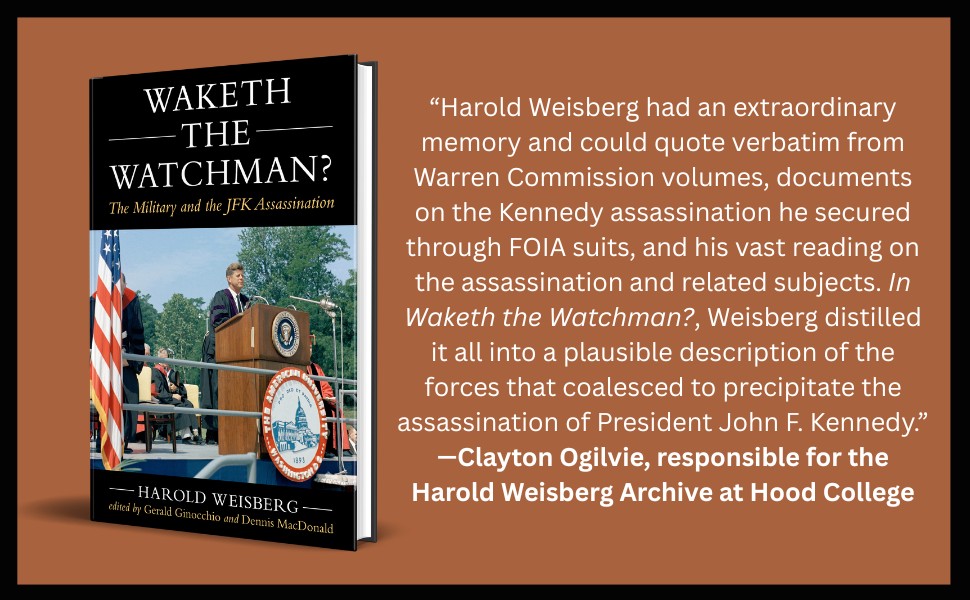
Courtesy of Clayton Ogilvie, click HERE to visit The Harold Weisberg Archive DIGITAL COLLECTION
Click HERE to shop the Harold Weisberg Author’s Page at Amazon
Click HERE to visit Alan Dale’s extraordinary interview program JFK Conversations
Copyright ©2026 AARC. All rights reserved.
