

* * *
“Murder Most Foul” and the Haunting of America
By: Timothy Hampton
One of the struggles of American literature in the new century has been to grasp the totality, not merely of spiritual and moral changes in daily life, but of the very range of events that have overtaken us. The proliferation of media, the speed of the news cycle, and the churning production of new forms of celebrity make up the chaotic backdrop to what used to be understood as “events” — major political changes, economic crises, floods, and plagues. At one level, this has always been a problem of American literature. But in earlier, less complicated moments, artists were able to grasp the larger fabric of American life through small flakes of experience which gestured — allegorically, as it were — to the larger catastrophes of our national life. The small towns of Faulkner, the paranoid communities of Pynchon, the tangled but discrete “cases” of Raymond Chandler, all reflect beyond themselves onto the guilt, corruption, and greed that power our national political “progress” and economic “growth.
Bob Dylan has worked, across his career, to engage and represent the bloody complexity of American identity and life. Many of his songs from the mid-1960s — “Desolation Row,” “It’s Alright Ma (I’m Only Bleeding),” “Stuck Inside of Mobile,” and so on — confronted the glitter and buzz of American life through a kind of visionary technique. The disjointed nature of much of Dylan’s work during the 1960s uses the very form of the lyric to evoke the chaos of daily life while whittling it down into digestible bits. Waves of information swirled around and through those songs, which in turn bestowed meaning on them through the structuring presence of the singer. It was as if simply registering the sweep of the news and spitting it back as a set of images (Einstein disguised as Robin Hood, the President of the United States standing naked, and so on), could provide a cognitive point of reference from which we could make sense of things. The song became a set of images to which we could return to develop a kind of mental map of daily life. When we hear the opening of “Highway 61″— “God said to Abraham, ‘Kill me a son’ / Abe said, ‘Man, you must be putting me on!’” — we suddenly grasp that the fiasco of the draft and Vietnam is not a story of national defense, but a story of generational sacrifice, with God now a neighborhood cop or Mafia thug and Abraham a terrified parent, uncertain of whether to beg or run. It’s all there, in one brief image and one narrative slice. The literary past — the Bible — is both mined and updated.
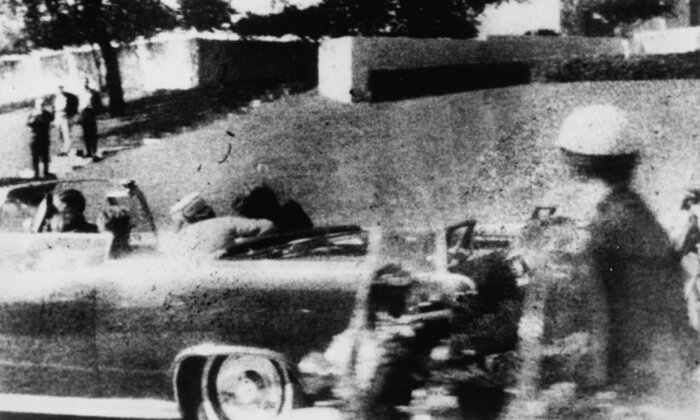
JFK’s murder was most foul, and that event paved the way, in Dylan’s mind, it would seem, for the process of long decay, the rootlessness and suspicion, that we have lived since then.
In the years since his visionary 1960s work, Dylan has turned to a variety of narrative forms to represent the sweep of national history. 1983’s “Blind Willie McTell” drew on the traditions of epic poetry to offer a bleak unmasking of the racism that both infects the country and powers one of its greatest artistic traditions, the tradition of the blues. 1986’s “Brownsville Girl,” written with Sam Shepherd, offered a post-modern story-within-a-story to explore the erosion of courage beneath the fake virtue of the Reagan years. And now comes “Murder Most Foul,” the 17-minute song released last month, in the midst of the coronavirus pandemic, against the backdrop of Donald Trump’s daily flood of lies and insults from the house where Lincoln, Roosevelt, and Kennedy slept.
“Murder Most Foul” is about the assassination of JFK. But it is also about what constitutes an event, and about how an event takes on meaning beyond itself. At still another level, it is about the haunting of America, about the role of spirit in the national life. The title comes from Shakespeare’s Hamlet, where the ghost of old Hamlet tells his son of his death: “Murder most foul, as in the best it is” (that is, all murders are foul), but “this most foul, strange and unnatural” (because fratricide and in secret), must be avenged. So we are in the land of ghosts, of the death of the “king,” as Dylan calls Kennedy at one point.
The style of Dylan’s song is of an incantation. The half-chanted vocal over piano chords and a bowed bass remains largely on a couple of notes. There is little melody to speak of, and the harmony only occasionally moves off of the tonic chord, to add a bit of drama by moving to the dominant. It tells the story of how the death of Kennedy, possibly a plot by Southerners eager to put Lyndon B. Johnson in power, was also the death of American purpose and direction. It matters not whether Kennedy was a good president or a bad one. His murder was most foul, and that event paved the way, in Dylan’s mind, it would seem, for the process of long decay, the rootlessness and suspicion, that we have lived since then: “The Age of the Anti-Christ has only begun,” he says at one point. The song jumps around in time and focus, imagining the president in conversation with his killers, lamenting what has happened, noticing the landmarks on the way to the hospital, as if Dylan’s persona were right in the car with the first couple.
Dylan once reflected that old folk songs are still alive for him — that the story of John Hardy, who “carried a razor everyday” and killed him a man on the West Virginia line back in the nineteenth century feels to him like it could have happened yesterday. Part of Dylan’s gift is to grasp and make legible what an event feels like, what it means, from the inside. To take us into the heart of the Kennedy experience Dylan draws on two literary traditions, which he weaves together across the song. First, most obviously, the song draws on the tradition of the murder ballad. To be more precise, it mobilizes a sub-category of that genre. Whereas conventional murder ballads make legends out of small-time killers (for example, Stagger Lee, who killed Billy de Lyons over a Stetson hat), here we have to do with the death of someone already famous and with the implications of that event.
Whereas conventional murder ballads make legends out of small-time killers, here we have to do with the death of someone already famous and with the implications of that event.
The event lives past its occurrence. To resolve this narrative problem Dylan mobilizes the Gothic or ghostly aspect of the murder ballad tradition. The literary advantage of using ghosts, as Shakespeare knew, is that they are unbounded by time and space. Perhaps the most famous musical Gothic is Lefty Frizzell’s 1959, “Long Black Veil,” in which a woman haunts the grave of the lover who died to protect her reputation. But there are multiple songs in which characters defy time and space. We can think, for example, of the Civil War-era ballad “Tom Dooley” (which Dylan mentions here), where the narrative is in both the third and the first person about someone about to be hung. Or of Marty Robbins’s 1959 hit, “El Paso,” in which, as in “Long Black Veil,” the narrator appears to be dead as he tells his story. These are songs about being haunted, about the spirit that moves about or sticks around after the body is dead. This is what “Murder Most Foul” is about. As Dylan points out midway through the song, they mutilated Kennedy’s body for science, but nobody ever found his soul.
The question of where that soul has gone is what Dylan explores in the long, second half of “Murder Most Foul.” Soul returns as voice. Anyone who knows the story of the Kennedy murder knows how it was framed. It was framed by the voice of Walter Cronkite, the trusted news anchor for CBS, who guided Americans through the days of agony and mourning as the dead president was buried and the transition to LBJ’s administration took place. Dylan has evoked Cronkite elsewhere, in the ironic 1976 adventure tale “Black Diamond Bay,” which he wrote with Jacques Levy. There, in the last verse, the narrator is sitting at home, “watching old Cronkite on the seven o’clock news.” He hears about a disaster and turns off the tube. In that song, the question of what is “an event” is quite clear. It’s what’s on the news. You can shut it out by turning it off. But you can’t turn off the murder of JFK. And where we would expect the voice of Cronkite, we here find the voice of the famous Disc Jockey Wolfman Jack, whom Dylan calls forth — “Wolfman, O Wolfman,” he intones — and from whom he requests music: “Play Oscar Peterson, play Stan Getz.”
“I am thy father’s spirit,/Doom’d for a certain time to walk the night,” said old Hamlet to his son. In a song about haunting, about the haunting of America, Wolfman Jack, the werewolf, is the fitting guide.
As Dylan points out midway through the song, they mutilated Kennedy’s body for science, but nobody ever found his soul.
If the song is about a great “event” in history, we could recall as well the tradition of the historical novel, which is also at work here. In that tradition, as the literary critic Georgy Lukács noted, the narrative runs, not through the great personages of history, but through the viewpoint of ancillary figures who show us obliquely what great events mean. And so, here, it is through Wolfman Jack that we will understand the meaning of Kennedy’s death. Thus, the last half of the song consists of Dylan’s persona asking the wolfman for songs. “Play…,” he begins at the start of the third verse. And for 11 minutes or so he unspools a list of songs, from “Dumbarton’s Drums” (a traditional Scottish song, known in the Civil War era) to Stevie Nicks. And it is here that the form of the song mirrors its message. For it is the radio, the medium of Wolfman Jack, that sends out messages through the night. Radio offers us ghostly messages. It brings the voice of the Other, of the past, of echoes and memories that come to you when you least expect it. You don’t even have to log in.
Dylan grew up listening to late-night radio blasted from the deep south up to Minnesota — blues, country, rockabilly. Dylan knows that radio is the medium of ghosts, and he suggests here that Wolfman Jack is the voice who can call up the ghosts of American identity. This is most appropriate, since Wolfman Jack made his name broadcasting from Mexico, via XERB, one of the legendary “Border Radio” superstations that purveyed popular music to the southwest and West Coast. The turn to Wolfman Jack is both the ghostly invocation — “Stay, speak!” says Hamlet to the ghost — and the modern American reinvention of the funeral dirge: “Beat the drum slowly, play the fife lowly,” ran the old cowboy lament, “Streets of Laredo,” which Dylan quoted in 1989’s “Where Teardrops Fall.” In this case, the Wolfman speaks from outside America, paradoxically giving the country its voice. The fact that it is a voice from Mexico who speaks above the crimes of southern white conservatives, determined to destroy, not only JFK, but his liberal brothers (“We’ll get them, too”), gives the song a deep resonance in our own moment.
Dylan knows that radio is the medium of ghosts, and he suggests here that Wolfman Jack is the voice who can call up the ghosts of American identity.
Around the turn of this century Dylan wrote several albums of songs that dealt with the idea of the ruin, the fragment, the broken shard. Songs such as “Tryin’ to Get to Heaven,” from 1997’s Time out of Mind, “Mississippi,” from 2001’s “Love and Theft,” and “Workingman’s Blues #2,” from 2006’s Modern Times, offered stories of lost souls, exiles at home, abandoned people struggling to find their way in a bleak economy, cut off from the past, from community, from stability. Dylan evoked their struggles through a disjointed writing style, stuffed with citations of other songs, bits of text taken from books and poems, as if the present were a field of broken artifacts, slivers of meaning and value after which we must all grope in the dark. In “Murder Most Foul” he offers something similar, except now in sonic terms. He calls for bits of song. What is the “voice” that can guide America after Kennedy? It is the voice of our music, of the echoes the come from the radio across the border. And through those echoes the event of Kennedy’s death resonates as well.
There is nothing nostalgic about Dylan’s journey through American music. He is clear-eyed about the triumphs and follies of the directionless generation that came of age after Kennedy. He evokes the foolishness of the Age of Aquarius, the silliness of Woodstock, the tragedies of Altamont and Kent State, Beatlemania. His narrative persona assumes, at one point, the place of self-indulgent Boomers, and at one level the song is a rewriting of Don MacLean’s “American Pie.” But Dylan is deeper and more imaginative. Again and again he asks the Wolfman for music, everything from Charlie Parker to John Lee Hooker. Not classic rock and roll — no Beatles, no Stones — rather, the blues, jazz, deep music, elegant music, Beethoven, Nat King Cole. Music becomes both the witness to American decline and the only thing that can keep the spirit of JFK alive. Our art is stained, but it is all we have. It is the vehicle of haunting and the evidence that we are a haunted people: “Seen the arrow on the doorpost/Saying this land is condemned,” sang Dylan in “Blind Willie McTell.” In that song, the voice of the great bluesman was seen as the alternative to the disaster of American history. Here, the violence of a single event resonates across a world of song, via shards of radio play, echoes, names, bits of sound.
Yet “Murder Most Foul” is not merely a celebration of the power of art. Like Hamlet, it is about how illusions and fictions seep into our very being. And thus, as we move toward the end of the song, the list of singers begins to alternate with fragments of everyday speech, with movie titles: “Play Misty for me,” he says, making a request for a song and naming a movie. “Play the 6 and the 9,” he goes on, “Play, ‘Frankly, Miss Scarlett, I don’t give a damn.’” American phrases, bits of cultural vernacular, now jostle for our attention in the mist, not on the ramparts of Elisinore, but in the sun at Love Field. The point seems to be that when we are haunted we slip easily, almost imperceptibly, in and out of art, proverb, cliché. And as the song ends it names itself in the last line, taking its place in the canon but also welding Shakespeare’s famous line onto an event in our own history, both personal and political.
As “Highway 61” re-upped the Bible for service in the present, now Hamlet speaks again. And by making it speak, the song reminds us that a great crime is still alive. The king could have died yesterday. Music both recalls the event and soothes our spirits. And henceforth, JFK’s ghost lives on in all of these songs. To sing them is to be reminded of his soul (in all senses of that term), but also to be confronted with the fact that, in every song we sing, our country is scarred by his murder, by murder most foul.
* * *
Afterword by Alan Dale
While preparing this article for publication, I consulted with the AI assistant (LLM) Claude to clarify the meaning of two words which were relevent to my perspective. Following is the complete transcript of the interaction that ensued:
Alan: Please share with me your assessment of this question: Is Bob Dylan’s “Murder Most Foul” best described as an epic liturgy or and epic litany?
Claude: My assessment is that “epic litany” is the more precise description, though “liturgy” captures something about the song’s larger ambition.
The case for litany. A litany is built on accumulation: a series of invocations or petitions, each echoing the same grammatical gesture. That is the engine of the song’s second half. After a first section that tells the assassination in a compressed, almost ballad-like narrative, the song turns into a long run of requests addressed to a radio disc jockey, naming songs, films, musicians, and cultural touchstones one after another. The structure is imperative and repetitive, with each item working as a petition. It is also the traditional mode of the litany that the speaker is not telling but asking, and asking on behalf of a mourning community. The catalog form has epic ancestry too, in the Homeric ship-lists and Whitman’s inventories, which supports “epic” as the modifier.
The case for liturgy. A liturgy is the whole ordered rite: a prescribed sequence with a communal, ceremonial purpose. The song does have that shape. It moves from the act of violence, to lament, to intercession, to a kind of consecration of the culture’s songs as the vessels of memory. The disc jockey functions as a priestly intermediary, and the music is offered as a requiem for a nation as much as for a man. That gives it a ritual weight a bare list wouldn’t have.
Where liturgy falls short. Liturgy implies communal participation and response: the congregation answers, the rite is shared. Here there is a single voice, and the response is left to the listener. The opening narrative section also doesn’t behave liturgically. It is closer to elegy and dirge. If the song were purely liturgical, the narrative of the killing would feel like a reading within the rite, whereas in practice it feels like the wound that the rest of the song tries to dress.
My conclusion. The song is best understood as an epic litany inside a requiem frame. The litany is the dominant mechanism, since the petitions and catalogs carry most of its length and its emotional logic. Liturgy is the larger genre it gestures toward, the sense that this recital is a rite of mourning the culture performs through its art. If you require a single term, litany is the more defensible, because it names what the text actually does line by line, while liturgy names what it aspires to be.
One caveat: the answer shifts with how strictly you define the terms. If “liturgy” is taken loosely as any ritualized act of collective remembrance, the two terms converge considerably.
I’d be curious whether you read the closing movement as a resolution of the rite or as a continuation of the petition.
Alan: My reading of the piece as a meditation on profound loss and profound consequence is that Mr. Dylan offers examples of musicians and others whose works may be viewed as both informed and beneficial to those who suffer, helplessly and without resolution, because of having to live in the world that emerged after JFK was taken from us.
Claude: Your reading strikes me as persuasive, Alan, and it also clarifies something my earlier answer left underdeveloped. I framed the catalog largely as petition, but your emphasis on consolation shifts the weight. The figures Dylan names are not merely invoked; they are offered as what remains available to a people who cannot undo the loss and cannot resolve it.
Several features of the text support you. The speaker’s requests are not for rescue or restoration but for company in the aftermath: songs for the wounded, music to be played for those left standing in the rubble. The names he chooses, from Billie Holiday and Etta James to Charlie Parker, Bud Powell, and Thelonious Monk, belong largely to a tradition that metabolized suffering into form. Many of those artists worked from within conditions of hardship and exclusion, so their art is already a demonstration of how one lives in a damaged world. And the song’s refusal of closure, with its closing sequence of requests for the “Murder Most Foul” itself to be played, suggests that Dylan understands the condition as ongoing rather than something to be mourned and then left behind.
That reading also complicates my earlier “litany” verdict in an interesting way. If the catalog is essentially a pharmacopoeia of consolation, then the song’s genre may be less about supplication to a higher power than about a community assembling its own resources for endurance. That sits somewhere between litany and what we might call a wake: an extended, communal sitting-with, where the roll call of the dead and the living works is itself the comfort.
Your phrase “profound consequence” seems especially important. The song insists that the assassination was not only a death but a hinge, after which the culture’s relation to trust, spectacle, and memory changed. The art Dylan names is partly a record of how people carried on regardless.
Given your own life as a jazz bandleader, I wonder whether you hear the musical selections as chosen for their emotional register, or for the particular way those artists transformed grief into form.
Alan: Both. Thank you for your very thoughtful assistance and clarification. I appreciate the depth and value of discussing such matters with you.
Claude: Thank you, Alan. The pleasure was mine. Your reading gave the discussion its real center, and the point that emotional register and the transformation of grief into form are inseparable in those artists is a good one. It may be exactly why Dylan reached for musicians rather than, say, statesmen or poets as his companions in the aftermath.
