Special to the AARC:
Following is a “First step” into the esteemed British researcher Malcolm Blunt’s studies of Richard E. Snyder’s employment with CIA and his career as a Foreign Service Officer of the U.S. Department of State. These short essays offer an emerging framework highlighting new questions and new perspectives. Best viewed as facets of an original and on-going work-in-progress, this is not a definitive last word. There will be more to come.
With gratitude to Marie, these works are dedicated to the late Gaeton Fonzi.
PART 1
INTRODUCTION
Why the CIA Dog Did Not Bark
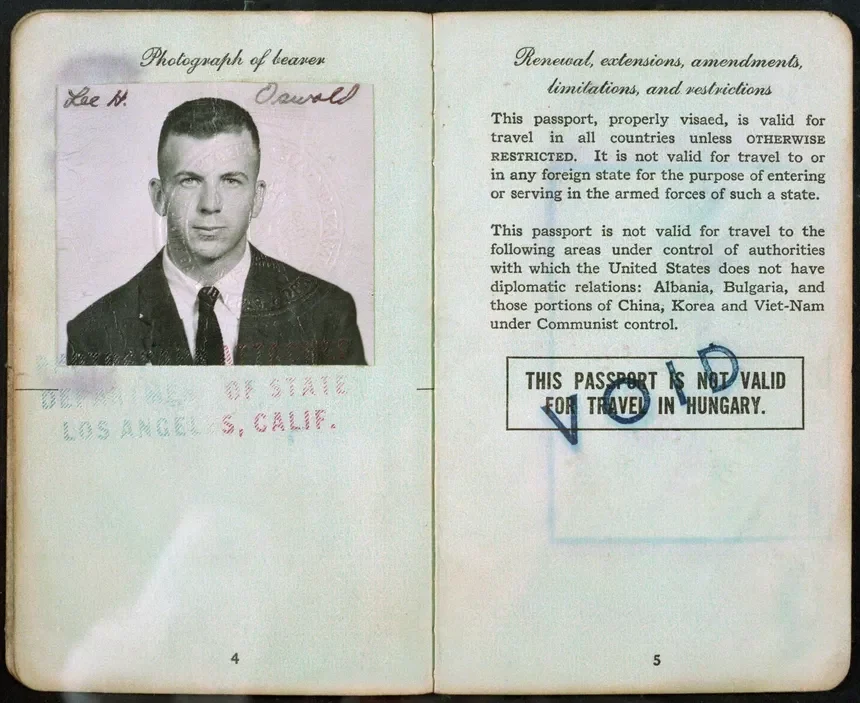
After more than 60 years we have yet to fully and confidently decipher that most enigmatic and oblique personage Lee Harvey Oswald, his motives, or his seemingly facilitated exit from the USMC and subsequent expedited admittance into the USSR. In this article I will attempt to shine some light into dark corners successfully closed off by CIA and others for many years. What am I talking about? Nothing less than a journey into the labyrinth of a CIA deep covert operation involving a witting “sheep dipped” Oswald sent to Moscow by the most tightly compartmentalized elements within the agency.
We need to focus on the 10/31/59 State Department communication incoming to CIA of which there are 15 copies. This is the official version of Oswald’s visit to the American embassy in Moscow where Oswald met Mr. Richard Snyder, a foreign service officer (FSO), and they discussed Oswald’s intent to defect and give special information to the Soviets.
At this point we must introduce an excellent HSCA analyst – Betsy Wolf – who writes in her notes: [The document number is 11112383…..which is I believe a CIA tracking number] “10/31/59, SD (State Department). Why route to O/S (Office of Security)?” Next, she asks herself, “what is significance?” What these undated Wolf notes confirm is the routing into CIA of the earliest Oswald information was to the Office of Security. It became clear to me later-on that, in fact, none of the early Oswald documents incoming from other government agencies (OGAs) made it to the Soviet Russia Division.
So, the big question is: Why?
During questioning by the HSCA, CIA Counterintelligence legend James Angleton stated that “it should have hit the Soviet Russia Division pretty hard.” That it did not demonstrates the “capture” of this Oswald information by the Office of Security.
The component tasked by that office to deal with counterintelligence matters was the Security Research Staff (SRS) headed up by General Paul Gaynor with Bruce Solie, John (Jack) Dempsy, and Bill Knott as his deputy chiefs.
A defector in Moscow such as Oswald was exactly that, a counterintelligence concern. We now know from the HSCA interview notes of Office of Security chief Robert Gambino that the trajectory through CIA for documents of other government agencies (OGAs) commenced with the Office of Mail Logistics (OML) which at that time was located within the Office of Central Reference (OCR) itself part of the Directorate of Intelligence (DDI). Because of a letter from H. C. Eissenbeiss[1] we can reconstruct some OML rules for dissemination from the period under review.
The State Department for instance had to comply with internal distribution requirements of the CIA via OML We can see on the slugline of the 10/31/59 State Department communication a box that simply states “CIA 15.” This means that 15 copies of the communication were provided by the State Department to the CIA for dissemination to their internal requestors for that information which in this case included Soviet Russia Division (SR) with a copy also going to Counter Intelligence (CI) Liaison, and the CI Staff. We will also see that Record Integration Division (RID) likely also received a copy in RID indexing.
In-order to be included on a distribution list CIA components had to submit their requirements to OML using Form 1604, a “Change in Cable Reference/Change in Dissemination” form. As powerful as the Office of Security was it would have to work within this system but compel OML to disseminate counterintelligence matters to the Office of Security/Security Research Staff.
In the case of Lee Harvey Oswald, the Soviet Russia Division was excluded from receiving information on Oswald – documentation that would normally be disseminated into Soviet Russian Division – and that information was instead routed to the Office of Security.
Headquarters Regulations tell us that the Office of Security never opened 201 files because it had its own standalone system. The files they did open were exclusively Office of Security files, that office had the “action” on these files and unless they passed the information on to other components within the Agency (which in Oswald’s case they did not do) then there was no movement of those files elsewhere within the system. Thus, Soviet Russia Division was cut out of the flow of Oswald information.
What does this mean? It means there is no way a 201 was going to be opened until the Office of Security was good and ready to release this information. Researchers who have read Anne Egerter’s[2] HSCA testimony will recall that she was puzzled as to why the Oswald documentation landed on her desk when she thought that Soviet Russia Division should be the component requesting the opening of a 201 file.
Why would the Office of Security/Security Research Staff go to such lengths to exclude Soviet Russia Division from the incoming Oswald documents and for what purpose? Angleton[3] in his testimony before the Church Committee in September 1975 described how in 1954, he “built a bridge between the Office of Security and Counterintelligence,” the resulting office of liaison was the Security Research Staff.
In recent times (1959) Angleton and CIA had lost the great GRU spy Pyotr Popov, having been arrested by the KGB. Angleton went on a deep dive searching for a possible “mole” who may have betrayed Popov to the Soviets[4]. Angleton’s suspicions were focused on Soviet Russia Division. The Oswald defection would test the waters at CIA surfacing anyone who would come looking at RID/Indexing for information on Oswald. Since Soviet Russia Division was excluded from receiving the Oswald information, the flagging of that interest would be routed to Angleton, exposing the penetrator because the mechanism under regulations was that anyone making such an enquiry had to leave their name, component, and telephone extension number!
Could the idea of sending a “witting[5]” defector to Moscow in order for the KGB to initiate enquiries with their “mole” in Washington be the solution to Angleton’s fears? To that end he worked with Bruce Solie of the Office of Security/Security Research Staff to capture the incoming Oswald State Department documents which is a clear example of a “mole hunt” at work.
On the 27th June, 1978 William F. Larson, Chief of the Management Staff, DDO, CIA testified to the HSCA about CIA systems and working practices based on his experience as a senior records officer. Mr Larson’s responses to HSCA staffer Michael Goldsmith reveal a shaded form of truth. Mr Larson hedges his responses but nonetheless what he tells us is often illuminating.
[Larson HSCA Security Classified Testimony, 6-27-78]
During his testimony Larson is shown certain documents and on page 74 of his testimony he is asked this question by Goldsmith “in your opinion is there anything unusual about the fact that this information about Oswald (giving information to the Russians) was received in October 1959 and the file was not opened until December 1960?” Larson replied “I am not surprised because apparently the action element which I would have considered to be USSR Branch in the Soviet Division either was not made aware of the contents of the incoming Moscow cable or if they were made aware of it they were not concerned about the fact that Mr Oswald had walked into the American Embassy and made the statement he did and they did not sense a counterintelligence or an operational aspect to it so nobody moved on it.”
Not concerned about Oswald giving secret information to the Soviets?! Methinks what Mr Larson is really saying is of course Oswald was a counterintelligence threat and this cable from Moscow should have hit the Soviet Russia Division – “pretty hard” – and even Angleton himself said so.
[With thanks to Melton and Wallace and their great book Spycraft.]
Paul Hartman and an Almighty CIA F#@k-up
As a few light bulbs are going off about Hartman and his credibility plus his bombshell testimony that on 11/23, when tasked by (Ray) Rocca, he searched everywhere inside CIA looking for LHO information. When he went to OS/SRS, he was told by General Gaynor that “they had nothing on Oswald.” He also said that “AG” was not in existence during the WC period, hence “AG” on LHO 201 cover sheet for the supposed time frame was in error. Hartman testified to that and was hammered by Scott Breckenridge for mistaken memory. I emphasize again, Hartman was a straight shooter and where he is attacked it is indicative of CIA trying to cover its ass. We need to drench Hartman in Klieg lights. Pete (Tennent “Pete” Bagley, retired Chief/CI/SRD) praised him for his ability to find hard to find info inside the Agency, ergo, “Paul always came through for me.”
Dialogue
Malcolm Blunt: I noticed that in Paul Hartman’s HSCA testimony that he seems an honest guy.
Pete Bagley: I knew Paul; his great passion in life was Line Dancing; he just loved doing that. He got into trouble in Turkey and was rescued by Ray Rocca who utilized his abilities in CI/R&A. Paul was a birddog; ask him to find anything, any information anywhere in the agency and he could do it. He was exceptional.
MB: So, a straight and accurate guy then?
PB: Oh yes; you could go to the bank with Paul. He always came through for me and for Rocca too.
Paul Hartman’s HSCA testimony surfaced a major problem for CIA because when he was asked about the computer code term “AG” he described it correctly as the “OI” code (other-identification/identifier). “AG” referring to an actual or potential defector to the Sino/Soviet bloc and/or their satellite countries. When Oswald’s file was allegedly opened in Dec 1960 by Anne Egerter, the OI code “AG” was added to the form 831 opening sheet because LHO had defected to the Soviet Union in Oct 1959. Hartman was certain that the “A” part meant communism. He then told the HSCA that at the time of the 201 opening, they had only gotten as far as using “AF.”
Hartman: “This code, ‘AG,’ was not yet in existence at the time of the assassination at all; because what I said a little bit ago, the Handbook gave us no provisions for indexing an American defector.”…”I remember very clearly that when it suddenly hit us somewhere in the center of the Warren Commission period (‘64) that, Holy Smoke, we wouldn’t even have the authority to index Oswald, really, or an American defector, anytime; nor did we have a code, an occupational code for that … so we went to the records system in two stages…”
Hartman explains that the first step is The Handbook, and then, The Machine System (computer), in-order-for them to give us a code (for American defectors).
Hartman is clear in his recollection (see page 17 of his HSCA testimony). He continues, “My presumption is that at the time of the assassination we had reached the ‘AF’ period and that the ‘AG’ was assigned sometime during the WC period because we had no code for American defectors until then.” Hartman recalled a computer specialist officer within the CI/Staff going nuts when he found out, “when we realized that we did not even have an occupational code for an American defector and no provision for indexing an American defector.”
Again, Hartman is also clear in his recall, (H testimony page 17) “my presumption is that at the time of the assassination we had reached the ‘AF’ period and that the ‘AG’ code was assigned sometime during the Warren Commission time-period because we had NO CODE FOR AMERICAN defectors until then.”
Hartman’s memory on this rests on the reaction of the CI/Staff computer specialist going nuts when he found out …“we realized that we did not even have an occupational code for an American defector and no provision for indexing an American defector.” As you might imagine this bombshell testimony got people’s attention and alarm bells started ringing at Langley.
CIA’s HSCA liaison officer, Scott Breckinridge, moved quickly into “damage control” mode firing off memos internally and to HSCAs Chief Counsel and Staff Director G. Robert Blakey. One such memo, OLC 79-Q113/a, dated 9th Feb 1979, seeks to dismiss Hartman’s testimony noting that the officer interviewed (Hartman) “was being asked to rely on his memory some 15 years old …as good as his memory is it betrayed him on one point” … “the record is quite clear that the symbol ‘AG’ was in existence prior to the assassination of President Kennedy. The entire matter was a non- issue from the beginning and simply required so much time because of the delay by the investigators in making a direct and formal inquiry about it.”
So, Scott Breckinridge addresses the salient points, i.e. the HSCA took too long to do the obvious requests for Handbook regs from that period (1959/60), and the officer, Hartman, displayed faulty memory on when the “AG” symbol came into being.
Well, not so fast, Mr. Breckinridge, not so fast.
Paul Hartman as described by Pete Bagley was a person you could ALWAYS depend on; in his words, “you could go to the bank with his words and his work.” Then we have the reference to the Handbooks of the period confirming that Hartman “misremembered.” I would proffer that in the face of Hartman’s disclosure Handbooks were very quickly rewritten or edited in-order-to confirm the veracity of Breckinridge’s statements. Then, of course, Mr. Breckinridge does not mention one word about the CI/Staff computer specialist whom Hartman described as going nuts when it was discovered in mid-1964 that no computer code existed for indexing U.S. defectors to Sino/Soviet bloc countries. Here we have Paul Hartman recognized as the “go to guy” in CI/R&A being dismissed for his faulty memory. I ask how likely is this legend of a documents/records man to forget such a bombshell moment, especially as the computer specialist became unhinged?
I tried to get some clarity from Ann Egerter’s May 17 HSCA testimony, but her memory seemed a bit fuzzy; when asked about what “AG” stood for, she could not remember. Asked if it (“AG”) was in her handwriting, she said “I do not think so, I forget,” and then goes on to confirm that she does not remember what “AG” meant (page 58/59 of her testimony).
According to Paul Hartman’s testimony, “AG” was not in existence when Ann Egerter handled the form 788 request. Period.
What does all this mean? Logically the possibility exists that the CI/SIG/State Dept list of defectors was merely a contrivance whereby the SRS and CI/SIG (Solie and Angleton) could further obfuscate their previous joint action which resulted in the Soviet Russia division being completely shut out of the Oswald defection dissemination. Or, as Ann Egerter tells HSCA ‘s Michael Goldsmith during her May 17 1978 testimony, “If we had been the only office on the staff it would have been suitable for that information (Oswald’s defector info and others) to go to us, but what I tried to point out before, I always wondered why it (Defectors List) HAD NOT BEEN SENT TO THE SOVIET DIVISION…because I obtain most of my information from the Soviet Division.” [emphasis added.]
So, even Ann Egerter was puzzled why the responsibility for opening of these defector files ended up on her desk. Breckinridge, recognizing that there was clearly something amiss with the Oswald opening sheet, writes to G. Robert Blakey: “The (HSCA) draft emphasizes the memory of the witness (a man with quite a good memory on some things) Unfortunately, his memory plays tricks on the institution of the‘AG’ symbol. Agency records show that it was in use prior to the assassination of President Kennedy. Perhaps the witness recalls learning of it during the investigation (JFK Investigation, 1964) and now believes that it was developed then but, the records show him to be in error. The problem is that the investigators sought the answers from people years after the fact rather than asking officially, when they finally did (ask) the answer was readily available. The lost time is recorded in the long treatment of a non-issue”
To recap, just so we’re clear: Paul Hartman, a near legend in CIA regarding records and documents has a faulty memory. Note that Breckinridge does not address the CI Staff computer specialist who “went nuts” over this matter in mid-1964.
CIA did not let go of this matter, realizing the implications could be dire for them, the Office of General Counsel (OGC) then got involved. They looked at the “AG” issue, emphasizing Breckinridge’s points and stating that the HSCA staffers pursued the “AG” matter because they thought “AG” was an abbreviation for “agent.” Interestingly, they go on to say that the HSCA report “elects to accept a recollection of a former employee” (Hartman). OGC then add that “agency records show that the symbol (“AG”) was in use at least a year prior to the opening of the Oswald file…OGC advised HSCA representatives accordingly.
Well now, whom does one believe? Paul Hartman, a rock-solid R&A records man with a top reputation, or Scott Breckinridge, the point man at CIA working to ensure that NO inconvenient facts surface. From my perspective; I saw the expression on Pete Bagley’s face as he praised Hartman, he trusted the man totally, thus I am inclined to believe Hartman’s memory rather than Breckinridge’s convenient surfacing of a probable reworked agency handbook.
The importance of CIA file machine listings on pages 54 and 55 of Hartman’s testimony (10/10/78) completely exposes the big lie: OS/SRS had a file on Oswald and then LIED to Hartman! Imagine that! They had to lie to cover up the OS/SRS/CI/SIG Oswald connection in 1959.
Addendum
This is worth emphasizing: Upon Lee Harvey Oswald’s defection on 31 October, 1959, 15 copies of the documented communication pertaining to that event were provided by the State Dept to CIA for onward dissemination to their internal requesters which was standard operating procedure. That OML dissemination normally led to the relevant SR Division components. As per Betsy Wolf’’s discovery (see attached notes) and Michael Goldsmith’s questions to W. Larson about the SR Division (see attached notes) and the fact that in May ‘61 Lynch of SR/CI was asking for the original Oswald material, WHY would they ask for this 1959 LHO info if they already had it? In my humble opinion this needs to be nailed down.
RID indexing is where “skeleton files” are kept that would contain basic bios on individuals of interest. We may again thank Melton and Wallace for their book Spycraft which includes important systems and management information. Even though we must provide the necessary context, we thank them because they give us the hard fact that at the time of LHO’s defection the most highly compartmentalized part of CIA was the SR Division. They go on to describe that SR did not use the Tube system for commo, that their commo was always in envelopes and hand carried by SCB couriers. Think about that for a moment: the SR Division was the most screened off part of CIA and Angleton pushes a mole hunt specifically there! I also thought that the piece (Melto/Wallace) describing the physical access into the SR/offices area was fascinating; a lady at a desk as a gatekeeper and if you did not have proven business there you did not get in.
It should be noted that Oswald, Webster and Petrulli, had all attempted to defect on a Saturday, when the American embassy was “officially” closed. Each spoke personally with Richard Snyder (whose affiliations and ultimate professional credentials are relevant to this discussion) and were told to come back when the embassy was open. Of the three, Webster was apparently the only one to do as he was told.
Researcher and author Gary Hill (The Other Oswald: A Wilderness of Mirrors; pub. 2020) calls this the “Saturday Defection Strategy.” It left the door open for the would-be defector to redefect at a later date. CIA knew that Richard Snyder’s office was bugged and that defection scenes such as these would be regarded by soviet authorities as probably[6] genuine.
It may be worth noting that within a short span of 18 months —1959-1960 — Oswald, Webster, Petrulli and six others “defected” to the Soviet Union with 7 among those 9 later redefecting (including Webster, who returned to America on 20 May, 1962 followed by Oswald, who landed with his wife and daughter just 24 days later in New Jersey on 13 June, 1962). While the Soviets had effectively recruited many spies within western nations, especially during the “Atomic” era, in the 30 years prior to that rash of 9 defections in ’58-’59, the number of defectors from the U.S. to the USSR who were not obviously engaged as atomic or other-type of spy activities was, according to Hill, 2! It would be very strange, indeed, if these statistics did not suggest strong evidence of a coordinated false defector program involving the State Dept. and the CIA.
PART 2
AN OLD PROBLEM REVISITED
By Malcolm Blunt
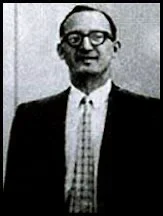
Richard E. Snyder (December 10, 1919 – January 9, 2012) was a United States Department of State official best known for his role as the senior Moscow consular official who handled Lee Harvey Oswald’s attempted defection to the Soviet Union in 1959 and his request in 1961 to return to US.
From October 1949 to September 1950 Snyder served in the Central Intelligence Agency. By his own account, he had no further links to the agency after that date, although according to agency records, he was used as a “spotter” at Harvard during his studies there to identify persons of potential interest to the Agency.
From 1950 to 1970 Snyder was employed as a United States Department of State Japanese and Russian specialist. Much of Snyder’s career was spent in Japan, but after he earned his Master’s degree in Russian Studies in 1956, Snyder served as a senior consular official at the U.S. Embassy in Moscow from July 1959 to July 1961. In Moscow he dealt with Lee Harvey Oswald (accepting Oswald’s U.S. passport in October 1959 and returning it to him in July 1961), met with the American defector to the USSR Robert Edward Webster on October 17, 1959, and attended the trial of U2 pilot Francis Gary Powers in August 1960. After returning to Japan, Snyder was later involved in preparing the restoration to Japan of administrative control of the Ryukyu Islands in 1972.
Upon retirement from the U.S. State Department, Snyder worked again for CIA and found placement within the Joint Press Reading Service (JPRS).
* * *
Richard Snyder was one of the first CIA officers to work officially for the State Department but unofficially under operational control by CIA. In other words, Mr. Snyder was formally employed as per State Department regulations, but his true affiliation was to the Agency (CIA). Mr. Snyder’s CIA secrecy oath was binding throughout his life, and he went to his grave keeping his secrets.
Mr. Snyder’s authorized employment history raises certain questions, and the HSCA clearly smelled a rat, but struggled to get past the Agency’s opaque responses to their enquiries. In this essay I will attempt to take the reader beyond “the CIA did it” mantra and demonstrate from their own documents the truth behind one of the Agency’s most closely guarded secrets.
* * *
Birch O’Neal had worked closely with James Angleton’s intelligence analyst Ann (Betty) Egerter within Counterintelligence, Special Investigations Group (CI/SIG). More than 59 years after the assassination, CIA finally released a deeply informative document buried in O’Neal’s Personnel File (RIF # 104-10291-10014). This document, released on 3/18/2025, explains how CIA officers could be morphed into Foreign Service officers. This Top-Secret U.S. Government/State Department/CIA agreement lays it all out in compelling detail. When I read this document, I was stunned because what we see is a striking example of CIA sources and methods which, as a rule, are never publicly released. It brought back for me the memory of a conversation I had at a conference with a CIA officer involved in document releases; when I argued that the Agency should release these old files she told me, “Just because they are old does not mean that they are not relevant;” and this “old” secrecy agreement, newly released, shows us in great detail the Cold War methodology employed by CIA in their internal operations.
From the very beginning, JFK assassination researchers have puzzled over whether-or-not Richard Snyder was a genuine State Department Foreign Service Officer (FSO). In a sense this is the wrong question given the fact that CIA always deny Foreign Service (FS) usage even unto their own. My close friend, Pete Bagley (Chief/Counterintelligence/Soviet Russia Division) denied that to me also. However, what we should pay attention to is that somewhere within CIA’s own systems and structure, significant Top-Secret (and above), highly compartmented components exist. These parts of the Agency are screened off from practically all other components, and only exceptional “need to know” credentials enable access to the sensitive information kept within these sensitive areas.
Such is the case with the Top-Secret information, the basis of an agreement between the United States government, the State Department and, at its very birth in 1947, the Central Intelligence Agency. It was determined to be essential that CIA employees specially selected by the Agency would be designated as FSOs to best facilitate CIA overseas operations. The “Chief of the Foreign Service Establishment” within the State Department would be cognizant of this relationship and, working with the Agency’s Assistant Director of Special Operations (ADSO), the line of authority would extend through senior staff at Office of Special Operations (OSO) who worked with the State Department Foreign Service establishment staff. Further, the “employee” line of authority would encompass the OSO Branch Chief in Washington, DC, the Chief of Operations at OSO and the ADSO, plus the Director of CIA (DCI). When an inevitable conflict between State Dept and CIA authority arose, the matter would be referred to the ADSO (CIA) for resolution, so CIA appears firmly in the driver’s seat in these arrangements. (See page 168 of Birch O’Neal’s Personnel file.)
[It is interesting to note the specific personnel who served in these positions when LHO defects in front of Snyder on 31 Oct., 1959.
Assistant Director of Special Operations – Richard Bissell.
Senior staff at Office of Special Operations would include Allen Dulles, Richard Bissell, and Frank Wisner.
The Branch Chief in Washington, DC, Office of Special Operations in October 1959 was Col. Aaron Bank, famous for creating the Army’s Special Forces unit.
It is helpful to understand the difference between the OSO Branch Chief and the OSO Chief of Operations. This is more than a semantical distinction. Branch Chief has the overall responsibility for the entire branch that may have several areas or departments where as “Operations” is usually a distinct department or division from other areas of the branch such admin or intel and each would have their own department/division heads.]
So, this brings us to the puzzle of Richard Snyder; that question, “Was he CIA or State?” The answer, the correct answer, is that under the U.S. Government/State Dept/CIA agreement, Snyder was in fact both. He was overtly employed as a State Department FSO and at the same time he worked covertly as a CIA employee.
One of the most significant and least recognized documents relating to our studies was released by CIA some years ago. This comes to us in the form of a letter from Lyle Miller of Office of Legislative Counsel (OLC) to Professor G. Robert Blakey in which Mr. Miller outlines the parameters by which Mr. Snyder will be guided during any HSCA testimony. CIA was clearly troubled if Snyder testified and was released from his Agency oath, then Mr. Snyder would be compelled to admit to CIA employment for his entire career. Accordingly, as a result, they wrote to Professor Blakey as follows:
“We note that the period of Mr. Snyder’s employment with this agency considerably pre dates the time period of interest to the committee investigation. Given this disparity in the time periods, it would seem that Mr. Snyder can be fully responsive to your enquiries without being released from the terms of his secrecy agreement with this agency. Accordingly, the agency considers that Mr. Snyder is still bound by the terms of this agreement.” [emphasis added]
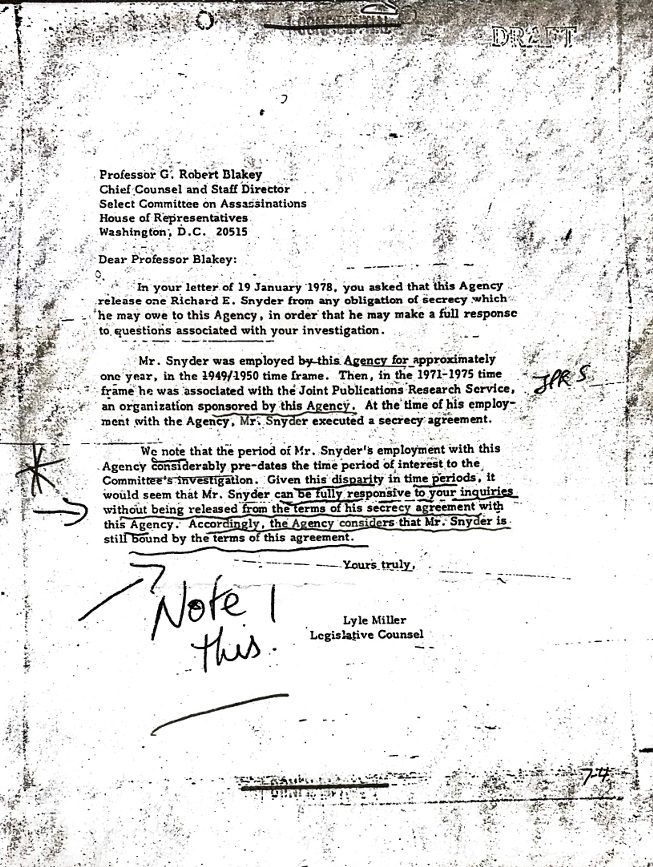
Of course, what this means is that Mr. Snyder could lie to the HSCA because he was still bound by his secrecy oath!
I want now to argue that this is exactly what Mr. Snyder did when interviewed by HSCA staffers Genzman, Leap and Lichtenfals on 14 April, 1978. Mr. Snyder denied any contact at all with CIA between 1950 and 1970 during his years with the State Department aside from a letter sent to the Agency after he retired from State when he asked about CIA contract work. However, we now know from released documents that Snyder was utilized by his friend, CIA officer Nelson Brickham, as a “spotter/recruiter” at Harvard during 1956/57. [See RIF # 180-10074-10330] In addition, it is now clear that Mr. Snyder’s Agency career went far beyond the short period he admitted.
For my reasoning on this we must look to Fritz Janney’s responses to CIA’s OLC which are fragmented and obfuscated in the extreme. The OLC, who were liaising with the HSCA, had to work extremely hard in drafting an understandable response to HSCA questions about Snyder’ personnel file.
Let’s look at some of the statements taken from the CIA official personnel file of Richard Snyder. [RIF # 104-10195-10004] In response to an HSCA query on “flag” in the file, Janney answers, “Office of Personnel file was flagged at the request of DD/CI (Deputy Director of Counter Intelligence) in order to be sure that any enquiries on Mr. Snyder would be referred to the Office of the Director of Personnel for further checks with DD/CI.” [emphasis added] [See RIF # 104-10135-10263]
My comment: Given that Snyder only worked for the Agency for about a year, seemingly doing not much, it’s curious that his file has flags (sensitivity indicators) on it. Then the Directorate of Operations (DO) gets involved. Their answer on the “flag”: “The case was of interest to the CI/Staff because CI was assigned the responsibility for the Oswald investigation and the requester would have referred to CI/Staff. Since only the DDO can query the DDO system an inquiry outside the DDO would not have reflected the interest, hence the notation.” This gobbledegook is meaningless except as an attempt to draw attention away from the fact that years after Richard Snyder has supposedly left CIA employment the highest echelons of the CIA are protecting his file before and during the HSCA investigation.
[Note: There is a Record & Routing sheet with Snyder’s personnel file created by Helms in 1970. Helms refers to a “matter of cover.” And Janney at the Office of Personnel writing to Lyle Miller at the Office of Legal Counsel does not know what that means. See Addendum 2b below]
9D-1SG House and Full Integrated Cover
When Mickey Goldsmith of the HSCA deposed John Whitten, [RIF #180-10131-10330] (CIA/Foreign Intelligence Staff/Chief/Western Hemisphere Branch/Desk 3) he asked the following:
Goldsmith: For example, here is a problem that the Committee is confronted with.
We recently introduced an employee who, as I mentioned earlier today, indicated that looking at his records, every indication on that record would be that he had retired from the Agency in the mid-5O’s when actually he had been with the Agency throughout and had continued one way or the other, whether it was to be paid by the Agency or by the State Department, he was still working for the Agency. There was no record of his Agency connection at Langley.
Whitten (Scelso) responds, “He may say that, but I do not believe it is true. There would certainly be files on him in the operational branches which were concerned with his work. He may have been purged from the normal personnel records and so on but he would have been continued in operational files which may have existed in only one file in the branch where he was managed.”
Mickey Goldsmith then summarizes back to him: “So, that it is possible that the personnel file would be purged in some manner or would be written up in a manner indicating that he was no longer with the Agency, and it is possible that there is just one operational file which indicates that in fact he was still with the Agency (CIA), and unless you knew this man’s cryptonym and went to that project file you would never know?
Whitten/Scelso: “Yes, very probably, yes.” [See RIF# 180-10131-10330; Transcript pagination 1-128 & 129, pages 130 & 131 as scanned]
Now, let’s look at some specific HSCA queries. They asked CIA what Project 9D-1SG House meant in relation to Snyder’s CIA personnel file. Fritz Janney’s Office of Personnel answered, “O.P. does not know what 9D-1SG House was; however, it is apparent that from our review of Mr. Snyder’s personnel action he was never assigned in that project.”
The DO (Directorate of Operations) answered the same question differently. [RIF # 104-10065-10062] They said, “9D-1SG House was an accounting project the purpose of which was to provide funds for administrative purposes. It had a budget of $5,000 and it was a project for the purposes of providing each program group, budgetary group, and foreign branch with an unvouchered funds account against which proper administrative and development costs not properly chargeable to a specific project may be charged.”
Intentionally convoluted to disguise the fact that it relates to placing CIA personnel in FSO positions. A disbursement of the mighty sum of $5,000.00 seems more than a bit light, unless your only program group expense is for coffee and donuts. (This is around $50,000.00 today – still loose change to an organization like CIA.)
Cutting through the CIA-speak and euphemistic language, here is my interpretation of Project 9D-1SG House:
9D-1SG House was indeed a CIA accounting project; part of the Top-Secret agreement between the U.S. Government, the State Department and CIA which enabled CIA officers to morph into what appeared to be genuine Foreign Service Officers. 9D-1SG House was compartmented and, as SG/FLAG, (which is the Covert Funding component of the Office of Security), this is where any disbursements to Snyder would be managed.
Outside the Office of Finance, unvouchered funds were probably handled by the Covert Funding component of the Office of Security.
There does appear to be some indication that within the Office of Personnel a parallel system of record keeping did exist. In other words, OP kept both “Official Personnel Files” on individuals and “Non-Official Personnel Files.” Snyder’s operational file was clearly kept in the branch which handled him (as per Whitten/Scelso’s comment) and this was the Office of Special Operations of CIA.
In his strangled responses to the HSCA queries, OP’s Fritz Janney gives us the heads up. He refers multiple times to the Snyder official personnel file indicating strongly the existence of an “unofficial” file. But, where would these non-official personnel records be located? Because of the level of secrecy involved, they would only be held within Counterintelligence/Operational Approval (CI/OA) and the Office of Security/Personnel Security Division (OS/PSD). As the questioning of CIA and their relationship with Snyder continued, Norbert Shepanek of DO commented, “All CI/OA files are restricted to CI/OA. This particular file (C 49500) was nothing but pages of names. Nobody knows what the list was and it has since been destroyed and all index cards to it have also been destroyed.”
Well, Mr. Shepanek, let me assist you. For a start, this file number (C49500) in Snyder’s personnel file relates to an Office of Security file. That it refers to CI/OA means that there was a live, active and sensitive interest in Snyder. I think it highly likely that the list of names that Shepanek mentions relates to the State Department employee waiting list which was copied to CIA and were then scrutinized so that the best candidates could be selected for CIA recruitment and usage. We should note that for decades the HSCA (Genzman et al) interview was classified by CIA. The only sentence in there that they would want to hide is where Snyder tells them that when he joined CIA he was on the State Department waiting list for employment. Nowhere in the HSCA investigation do we see any mention of the Top-Secret agreement between CIA and State for the Agency usage of individuals who will be treated as complete State Department Foreign Service officers. The second agreement between State and CIA specifies that whilst completely working as a foreign service officer, he would be under the operational control of CIA.
EPILOGUE
The twofold answer and more by CIA to the HSCA query about “Project 9D-1-SG/HOUSE” is indicative of a problem area relating to Snyder’s employment. If we accept that it was an “accounting project,” and I do, then we must go beyond the “matter of fact” explanation of that crypt which the Agency provided to the HSCA.
According to CIA, a “refer on” notice was placed in the Snyder OP file on 4/10/64 which said, “Any inquiry from or about Richard Snyder should be referred to the Office of the Director of Personnel who had ‘additional information.” Now then, CIA would have us believe that this information related to the Oswald investigation by the Warren Commission. However, noted on the control card was the comment that the “additional information” was merged with the official file on the 29th June 1974 (interesting timing, note Senate Select Committee on Intelligence (SSCI) was about to investigate). When CIA talks about “merging” or “consolidating” one must always pay attention because this is often when inconvenient facts are culled from the file and relegated to the dustbin of history.
I believe that SG/HOUSE and other “SGs,” yet uncovered, relate to the special funding arrangements as detailed between U.S. Government, State Department, and CIA — where CIA employees on the State Department “waiting list” were then utilized by the Agency as Foreign Service Officers acting on behalf of CIA interests. The payments in place to the CIA employees is explained in the Special Secrecy Agreement between U.S. Government, State Department and the Agency. These CIA payments probably coming from the CIA Confidential Funds Branch would by necessity have to be highly compartmented. The “SG” crypt would relate to the special funding payments between CIA and the State Department in order to support multifarious operations carried out by CIA employees living as full-cover FSOs.
I am sure interested researchers will take note that in 2023, all 50 pages of the Snyder personnel materials were finally released. It begs the question, for what possible reason were they holding so tightly to Snyder’s information after 60 years?
Note
To emulsify means to mix two ingredients that do not combine easily, such as oil and water
It should be noted that the above emerged during a period of unique power and influence that was being exercised by the Dulles brothers. While it is true we should resist unnecessary speculation, it is nonetheless easy to imagine that some issues of consequence were being discussed after hours, perhaps during discreet late-night telephone conversations, where issues of mutual concern between the Secretary of State and the Director of Central Intelligence were being worked out.
A deeply informed and highly intelligent Agency officer, now retired, has summarized this unprecedented coalition between brothers John Foster and Allen Dulles in this way:
He very quickly understood the issue of CIA vs. Department of State and asked if I had ever made a salad?
I said, “Yes.”
He said, “Did you make the salad dressing by mixing oil and vinegar?”
Again, I said, “Yes.”
He replied, “Well, then you know that, at first, oil and vinegar repel each other and don’t combine or emulsify until after you shake them together. That’s the Dulles brothers managing, on the one hand, the diplomats who are paid to lie overtly, while on the other hand, the clandestine intelligence service personnel running secret ops who are paid to lie covertly.
John Foster was already deceased by the time of Oswald’s defection on October 31 of ’59 (he died 24 May of that year). Perhaps we should take the advice of my friend, a long-term CIA retiree, and underline the uniqueness of the Dulles brothers’ era of influence, during which time each stood alone at the top of their respective fiefdoms when the lines separating the operational methods and objectives of the State Department and CIA’s operational methods and objectives were being “shaken together and emulsified.”
* * *
Addendum 1
CIA officer Joseph Burkholder Smith was interviewed by the HSCA 5-8-78: RIF #180-10070-10404.
All the funds destined for clandestine operations are unvouchered funds. The salary of clandestine officers came from such unvouchered funds. Such funds are not really “unvouchered,” in the true sense of the word since they are strictly accounted for within the Agency, but that term is meant only to differentiate them from funds spent on overt operations. The money that paid project activities are unvouchered funds. However, the Division chiefs had their own funds from which they could finance hip pocket operations which were only accounted for between the division chief and the Deputy Director of Plans.
Addendum 2a
Among the most compartmentalized components of CIA was Counterintelligence Special Investigations Group, (CI/SIG) which dealt with, among other things, mail intercepts. Before that program was taken over by CI/SIG it was identified by the crypt/digraph, SG/LATERAL (the OS digraph used before Angleton took it over and it became HT/LINGUAL), thus confirming that “SG” represents a highly compartmentalized operation. So it is that any reference to “SG” in the Snyder files indicates special sensitivity requiring special handling.
Addendum 2b
SG/FLAG, which is the Covert Funding component of the Office of Security, is where any of the CIA FSOs would get their salaries paid. The signpost is SG/HOUSE which informs us that funding stream as coming from the O/S. Point also is SG/LATERAL, the precursor to HT/LINGUAL; so, sensitive OS interests relate to the OS digraph “SG” which is not to say that there aren’t other, less sensitive, OS activities like for instance, SG/SWIRL, which is the polygraph people. I never twigged that this SG digraph could be so important. Researchers need to look for any references to “SG,” because that materially alters the importance of the whole of any document where it appears should require a closer look.
Addendum 2c
I originally had Snyder as probably paid with unvouchered funds via Confidential Funds Branch whilst he was “officially” with CIA, then covert funding when he went to work as a CIA covert for the State Department, very much like U S Customs and Cesario Diosdado. State Department would issue his salary as a real FSO and CIA Covert Funding Branch would pick up the tab via the OSO where this unique deal between the agencies was managed whereby CIA operatives were documented as legit FSO’s.
I see now that Confidential Fund Branch payments are a red herring, anybody would get these. The killer is the reference to SG House left in Snyder’s personnel file by mistake when it was gutted prior to Church Committee. Snyder was being funded in his doings by the OS Covert Funding Division, therefore he was involved in super-sensitive activities. The difficulties explaining SG House, the list of names and flag on file to HSCA by CIA are the telltale signs. Snyder was switched from unvouchered whilst in CIA overt to OS covert when he was plucked from the State Department waiting list.
My thanks to my dear friends Alan Dale and the extraordinary Kate Willard, whose deep understanding and editorial acumen contributed greatly to this work. Also thanks to Joe Backes from Justice for Kennedy who also contributed to this article.
Malcolm Blunt
* * *
Davis Eugene Boster – Wikipedia
[1] H. C. Eisenbeiss was the Director of the Central Reference Service at the CIA, as noted in a memorandum dated February 24, 1972, which discussed unclassified CIA publications. The memo, which was approved for release in 2000, outlined various unclassified publications produced by the CIA, including biographic reference aids like the monthly Chiefs of State and Cabinet Members list and comprehensive directories of officials from the Soviet Union, China, East Europe, and Cuba. Eisenbeiss’s role in the Central Reference Service is further confirmed by the document’s authorship and approval signatures.
[2] Ann Egerter, a CIA counterintelligence officer, played a central role in the agency’s handling of Lee Harvey Oswald’s file. She opened a 201 file on Oswald on December 9, 1960, while he was still in the Soviet Union, a move that has fuelled speculation about his potential ties to CIA. Egerter worked under James Jesus Angleton in the Special Investigations Group (SIG), which was known as “the office that spied on spies” and was tasked with investigating CIA employees suspected of espionage or security risks. Her testimony before the House Select Committee on Assassinations (HSCA) confirmed that SIG’s primary purpose was to investigate Agency personnel who were under suspicion.
[3] James Jesus Angleton (December 9, 1917 – May 11, 1987) was an American Central Intelligence Agency (CIA) officer who served as chief of Counterintelligence of the CIA from 1954 to 1974.) A supremely controversial figure, he was widely regarded as the dominant counterintelligence officer in the non-communist world for 20 years.
[4] For an unprecedented examination of the decades-long search within CIA for a mole working for the KGB, see Uncovering Popov’s Mole by John M. Newman (2022).
[5] See The Devil Is in The Details, Alan Dale, Malcolm Blunt (2020), pg. 345: Tennent “Pete” Bagley to Blunt on the question of Lee Oswald as a false-defector to the USSR: “Okay, was he (meaning Oswald) witting or unwitting?” Blunt: “You can’t ask me that question. How would I know?” Bagley: “No! No! You have to know!” Blunt: “Alright, unwitting.” Bagley: “No! He would have to be witting!”
[6] See British spy George Blake and what he gave up to the Soviets regarding false defector programs.
Copyright©2026 Malcolm Blunt. All rights reserved.
