Jeff Morley recently wrote an article on JFK Facts about Evelyn Lincoln’s unpublished memoir, I Was There (written in the 1980s). It is interesting that she said “From the catbird seat that I had during my 12 years as John F. Kennedy’s Personal Secretary I would have to say that, in my opinion, President Kennedy’s death in Dallas, Texas, was a deliberate professional political murder, planned by a group in government who wanted him removed from office.” (1)
This in fact is not new information as we already aware that she had these views. She firmly believed JFK was a victim of a conspiracy. She told Richard Duncan, a teacher at Northside Middle School in Roanoke on 7th October 1994: “As far as the assassination is concerned it is my belief that there was a conspiracy because there were those that disliked him and felt the only way to get rid of him was to assassinate him. These five conspirators, in my opinion, were Lyndon B. Johnson, J. Edgar Hoover, the Mafia, the CIA, and the Cubans in Florida.” (2)
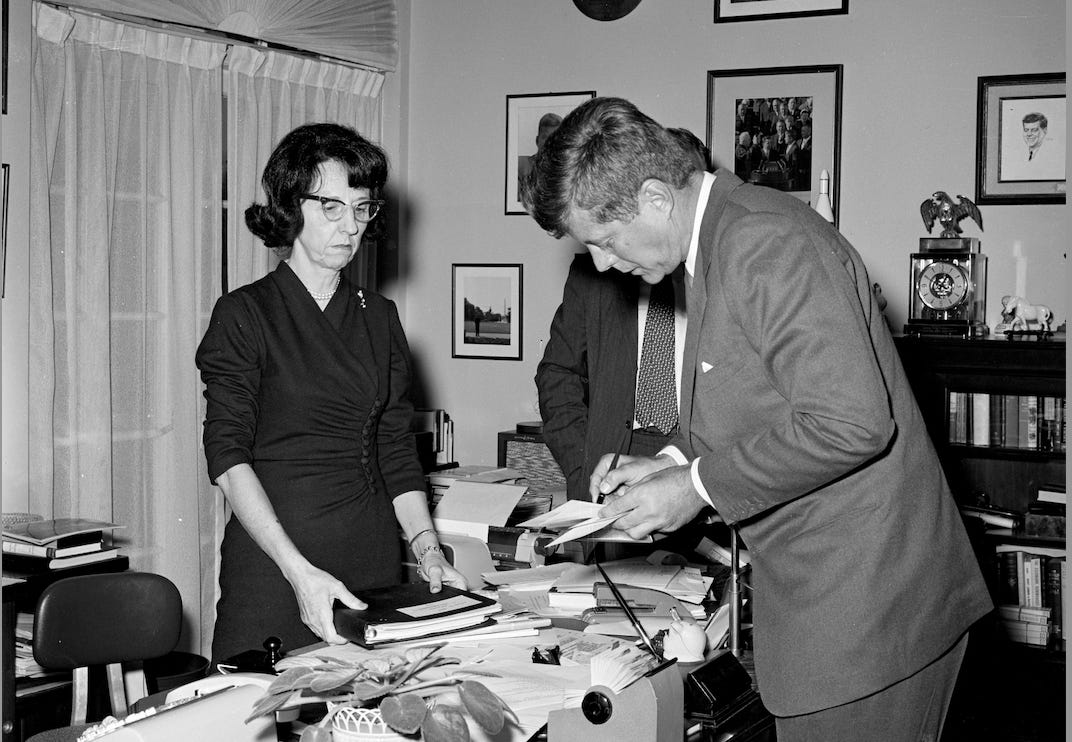
In her recently published memoir, she adds the possibility that others were involved. She suggests that the Ku Klux Klan because of JFK’s policies on Civil Rights. Another possible enemy was hawks in the military who were upset by his statement at a Press Conference on October 31st when he was asked: “Mr. President, back to the question of troop reductions… is there any speedup in the withdrawal from Vietnam intended?” The President answered: “Well, as you know, when Secretary McNamara and General Taylor came back, they announced that would expect to withdraw a thousand men from South Vietnam before the end of the year, and there has been reference to that by General Harkins. If we are able to do that, that would be our schedule.” (3)
All she has done in her unpublished memo is to list all of JFK’s enemies. However, she provides no evidence that any of these people were responsible for his death. Therefore, her memoir is not relevant to any serious investigation into the assassination.
The most important contribution that Evelyn Lincoln made to the investigation is her book, Kennedy and Johnson (1968) when she gives us an insight into JFK’s attitude towards Lyndon Johnson. Lincoln explains that JFK was worried about the consequences of the Bobby Baker scandal:
“The Bobby Baker case, came to light in September 1963 when a vending company filed a suit against Baker for not fulfilling a contract. The news and the reports that were filtering in about Bobby and his transactions were disturbing to the occupants of the White House for two reasons. First, Bobby Baker had used his connections to help swing doubtful business deals his way. Although he was no longer on Mr. Johnson’s staff, he had a way of beginning a business conversation with, ‘Well, Lyndon told me the other day.’ If you worked for a United States Senator, Democratic or Republican you knew Bobby Baker, Secretary to the Majority. His relationship with Mr. Johnson, then Majority Leader, was extremely close.” She then quotes LBJ as saying “Bobby is my strong right arm. He is the last person I see at night and the first person I see in the morning.”
Lincoln points out: “Senator John Williams, a Republican from Delaware, became interested in the case and started to do some investigating on his own…. At the same time, the Department of Justice started an investigation. They both dug in more deeply. Pressures were mounting, Bobby Baker was in trouble and on October 7, 1963, he resigned.”
JFK now saw LBJ as a liability and that the Bobby Baker scandal had the potential to damage the administration. The next extract from the book is important in understanding the possible involvement of LBJ in the assassination and its cover-up.
“As Mr. Kennedy sat in the rocker in my office, his head resting on its back he placed his left leg across his right knee. He rocked slightly as he talked. In a slow pensive voice he said to me, ‘You know if I am re-elected in sixty-four, I am going to spend more and more time toward making government service an honourable career. I would like to tailor the executive and legislative branches of government so that they can keep up with the tremendous strides and progress being made in other fields. I am going to advocate changing some of the outmoded rules and regulations in the Congress, such as the seniority rule. To do this I will need as a running mate in sixty-four a man who believes as I do.’… I was fascinated by this conversation and wrote it down verbatim in my diary. Now I asked, ‘Who is your choice as a running-mate?’ ‘He looked straight ahead, and without hesitating he replied, ‘at this time I am thinking about Governor Terry Sanford of North Carolina. But it will not be Lyndon.'” (4)
By November 1963 John F. Kennedy realised that Lyndon B. Johnson had become a problem as vice-president as he had been drawn into political scandals involving Fred Korth, Billie Sol Estes and Bobby Baker. According to James Wagenvoord, the editorial business manager of Life, the magazine was working on an article that would have revealed Johnson’s corrupt activities. “Beginning in later summer 1963 the magazine, based upon information fed from Bobby Kennedy and the Justice Department, had been developing a major newsbreak piece concerning Johnson and Bobby Baker. On publication Johnson would have been finished and off the 1964 ticket (reason the material was fed to us) and would probably have been facing prison time. At the time LIFE magazine was arguably the most important general news source in the US. The top management of Time Inc. was closely allied with the USA’s various intelligence agencies, and we were used after by the Kennedy Justice Department as a conduit to the public.” (5)
Phil Brennan, a journalist working for The National Review, argued that the Washington press corps had buried the stories about the Bobby Baker scandal and the connections with Johnson. However, John J. Williams, the Republican Party senator for Delaware, called upon the Committee on Rules and Administration to investigate the financial and business interests and possible improprieties of Baker. Brennan points out: “A few days later, the attorney general, Bobby Kennedy, called five of Washington’s top reporters into his office and told them it was now open season on Lyndon Johnson. It’s OK, he told them, to go after the story they were ignoring out of deference to the administration.” (6)
John Williams was known as “Honest John” and “the conscience of the Senate” because of his investigations into the corrupt activities of officials in the Harry S. Truman and the Dwight D. Eisenhower administrations. This included the downfall of General Harry H. Vaughan (1951) and Sherman Adams (1958). In September 1963 Williams began to look into the business activities of Bobby Baker. On 7th October, Baker resigned from his post as Johnson’s Senate’s Secretary. Three days later, Williams introduced a resolution calling for an investigation by the Senate Rules Committee. (7)
Don B. Reynolds was a friend of Bobby Baker. In 1957 Reynolds was asked to arrange Lyndon B. Johnson’s life insurance policy. “That was in 1957, only two years after Senate Majority Leader Johnson had suffered a heart attack. The Senator was having trouble finding an insurance company that would give him life insurance. Reynolds went looking on Johnson’s behalf, talked to three companies, and finally found that the Manhattan Life Insurance Co. would write the policy. Manhattan issued a first policy of $50,000, and shortly afterward, when it had covered part of its risk through a reinsurance company, issued another policy of $50,000 for Johnson.” (8)
Baker also introduced Reynolds to a large number of people that resulted in him signing insurance deals. This included Harry S. Truman, Jimmy Hoffa, Fred Black, Matthew H. McCloskey and Nancy Carole Tyler. Baker admitted in his autobiography, Wheeling and Dealing (1978): “I had entered into an agreement with Reynolds, a fellow South Carolinian, to steer insurance customers to him in exchange for a small piece of the business and a commission on any policies he wrote as a result of my efforts.” (9)
Reynolds claimed that over ten years he had “paid Baker some $15,000 for putting him in touch with the right people.” At a closed session on 22nd November 1963, Reynolds told B. Everett Jordan and his Committee on Rules and Administration that Johnson had demanded that he provided kickbacks in return for him agreeing to this life insurance policy. This included a $585 Magnavox stereo. Reynolds was also told by Walter Jenkins that he had to pay for $1,200 worth of advertising on KTBC, Johnson’s television station in Austin. Senator Robert Byrd asked Reynolds if he had evidence that the stereo was a gift from him. Reynolds replied: “The invoice delivered to Johnson’s home showed that the charges were to be Reynolds.” (10)
In his autobiography Baker admitted that Reynolds was telling the truth about being forced to advertise on KTBC: “Johnson was supersensitive to criticism that he used his public offices to add to his personal wealth, which was founded on radio and television properties. He avidly promoted the fiction that Lady Bird Johnson was the business genius… It was no accident that Austin, Texas, was for years the only city of its size with only one television station. Johnson had friends in high places among those who controlled the broadcast industry. George Smathers was his man in the Senate. Bob Bartley, a member of the Federal Communications Commission, just happened to be a nephew to LBJ’s patron, Speaker Sam Rayburn.” (11)
Reynolds also told of seeing a suitcase full of money which Bobby Baker described as a “$100,000 payoff to Johnson for his role in securing the Fort Worth TFX contract”. Reynolds also provided evidence against Matthew H. McCloskey. He suggested that he given $25,000 to Baker in order to get the contract to build the District of Columbia Stadium. According to the New York Times: “He (Reynolds) charged that Mr. Baker had received a $25,000 contribution for the 1960 Democratic Presidential campaign from Matthew H. McCloskey, builder of the $20 million D. C. Stadium in Washington, a prominent Democratic fund-raiser. The contribution, he said, was in the form of an overpayment by the McCloskey concern for a premium on a performance bond for the stadium that Mr. Reynolds’s company had written. Mr. Reynolds said he had turned the money over to Mr. Baker on Mr. McCloskey’s instructions.” (12)
Reynolds’ testimony came to an end when news arrived that President John F. Kennedy had been assassinated. Abe Fortas, a lawyer who represented both Lyndon B. Johnson and Bobby Baker, worked behind the scenes to keep this information from the public. Johnson also arranged for a smear campaign to be organized against Reynolds. To help him do this J. Edgar Hoover passed to Johnson the FBI file on Reynolds. (13)
Reynolds began telling friends and associates that Johnson was involved in the assassination of Kennedy. According to a FBI memorandum Reynolds had told an insurance executive that, “J. Edgar Hoover of the FBI had collected sufficient data to prove that President Johnson was involved in the assassination of the late President Kennedy. Reynolds stated that Governor Connally of Texas had been an accomplice of President Johnson’s in the assassination of the late President Kennedy. Reynolds also told Megill that Clint Murchison had kept Oswald in a hotel in Dallas for several days prior to the assassination.” (14)
According to an interview that Reynolds gave to the Federal Bureau of Investigations: “Reynolds prefaced his comments with the statement that he had been a long-time friend and associate of Robert G. Baker, a former Secretary for the Majority, United States Senate. He said on January 20, 1961, on the inauguration of President Kennedy, he, Reynolds, spent the majority of the day in Baker’s offices or in the Capitol Rotunda. He stated there were many people present in Baker’s office during the day, including his wife. Reynolds said that during a discussion with Baker on that date, Baker stated while referring to the swearing in of Kennedy, words to the effect that the s.o.b is being sworn in, but he will never live his term out. He will die a violent death.” (15)
On 10th January, 1964, Johnson telephoned his friend George Smathers and asked him to do what he could to stop the Committee on Rules and Administration from releasing Reynolds’ testimony: “They had this damned fool insurance man, in and they had him in a secret session and Bobby (Baker) gave me a record player and Bobby got the record player from the insurance man (Don Reynolds). I didn’t know a damned thing about it. Never heard of it till this happened. But I paid $88,000 worth of premiums and, by God, they could afford to give me a Cadillac if they’d wanted to and there’d have been not a goddamned thing wrong with it…. There’s nothing wrong with it. There’s not a damned thing wrong. So Walter Jenkins explained it all in his statement.” Smathers’ replied that he would try to persuade B. Everett Jordan to suppress the testimony. (16)
However, on 17th January 1964, the Committee on Rules and Administration voted to release to the public Reynolds’ secret testimony. Johnson responded by leaking information from Reynolds’ FBI file to Drew Pearson and Jack Anderson. On 5th February 1964, the Washington Post reported that Reynolds had lied about his academic success at West Point. The article also claimed that Reynolds had been a supporter of Joseph McCarthy and had accused business rivals of being secret members of the American Communist Party. It was also revealed that Reynolds had made anti-Semitic remarks while in Berlin in 1953. (17)
The New York Times reported that Lyndon B. Johnson had used information from secret government documents to smear Reynolds. It also reported that Johnson’s officials had been applying pressure on the editors of newspapers not to print information that had been disclosed by Reynolds in front of the Senate Rules Committee. “Revelations that persons in or close to the White House had had a hand in making available such information to impugn Mr. Reynolds’s testimony has caused sharp criticism from Republican members of Congress and from some segments of the press.” (18)
Of course, none of this information provides any evidence that LBJ was involved in the assassination of JFK and its cover-up. What it does do is to show that LBJ was a lucky politician. Napoleon Bonaparte has been quoted as saying: “I’d rather have a lucky general than a good one.” Napoleon believed that “luck” in a commander was a byproduct of a “prepared mind” – the ability to recognize and seize a passing opportunity that others might miss. Yes, that sounds like LBJ.
(1) Jefferson Morley, JFK’s Secretary Called His Assassination a Professional Political Murder (27th March 2026)
(2) (Evelyn Lincoln, letter to Richard Duncan, a teacher at Northside Middle School in Roanoke (7th October 1994)
(3) Evelyn Lincoln, I Was There (c. 1982)
(4) Evelyn Lincoln, Kennedy and Johnson (1968) page 129
(5) James Wagenvoord, email to John Simkin (3rd November 2009)
(6) Phil Brennan, Newsmax (18th November 2002)
(7) Clark R. Mollenhoff, Despoilers of Democracy (1965) page 284
(8) Time Magazine (31st January 1964)
(9) Bobby Baker, Wheeling and Dealing (1978) page 83
(10) Time Magazine (31st January 1964)
(11) Bobby Baker, Wheeling and Dealing (1978) pages 82-83
(12) New York Times (1st December 1964)
(13) Clarence M. Kelly, Director of the FBI, memorandum to Laurence Silberman, the Deputy Attorney General (30th January 1975)
(14) Cartha D. DeLoach, memorandum (22nd January 1964)
(15) Federal Bureau of Investigations (24th January 1964)
(16) Telephone conversation between Lyndon B. Johnson and George Smathers. (10th January 1964)
(17) The Washington Post (5th February 1964)
(18) New York Times (12th February, 1964)
John Simkin
Supplement
Regarding the suppressed article in Life magazine about LBJ’s corruption, the information came from an email sent to me by James Wagenvoord, the editorial business manager of Life. “Beginning in later summer 1963 the magazine, based upon information fed from Bobby Kennedy and the Justice Department, had been developing a major newsbreak piece concerning Johnson and Bobby Baker. On publication Johnson would have been finished and off the 1964 ticket (reason the material was fed to us) and would probably have been facing prison time. At the time LIFE magazine was arguably the most important general news source in the US. The top management of Time Inc. was closely allied with the USA’s various intelligence agencies, and we were used after by the Kennedy Justice Department as a conduit to the public.”
It has been suggested that it would not have been in the interest of Robert Kennedy to provide information about the illegal activities of LBJ. I disagree.
The FBI first became of Bobby Baker’s corrupt activities in November 1962, after electronic microphones (“bugs”) placed in the offices of Ed Levinson, who was suspected of being an important member of the Mafia. The FBI agent notified FBI chief J. Edgar Hoover of the references early in 1963 because, “I thought it was important for Washington to be aware of the possible political influence of Ed Levinson.”
Hoover also passed this information onto LBJ because he knew Baker was closely linked to the vice-president. Phil Brennan, a journalist working for The National Review, argued that the Washington press corps had buried the stories about Bobby Baker corrupt activities and the connections with LBJ.
However, John J. Williams, the Republican Party senator for Delaware, found out about this and in September 1963 called upon the Committee on Rules and Administration to conduct an investigation of the financial and business interests and possible improprieties of Baker. Brennan points out: “A few days later, the attorney general, Bobby Kennedy, called five of Washington’s top reporters into his office and told them it was now open season on Lyndon Johnson. It’s OK, he told them, to go after the story they were ignoring out of deference to the administration.”
Bobby Kennedy and other political advisers were appalled when JFK decided to have LBJ as his vice-president. They all knew that LBJ was corrupt and although he might help win Texas, in the long-term, his place on the team, could damage the presidency. RFK knew that when the Committee on Rules and Administration reported back it would bring about bad press for JFK. It was considered that the best strategy was to get rid of LBJ as soon as possible so that it would not be the main topic of the 1964 Presidential Election. LBJ was tipped off about this in November 1963 by Everett Jordan, the Democratic chairman of the committee. If JFK had not been killed LBJ would have been forced from office. Even if LBJ had not been involved in the conspiracy to kill JFK, he had every reason to want the world to believe that Lee Harvey Oswald, a man with no links to LBJ, to be a lone-gunman.
Postscript
Have you seen Todd S. Purdum interview with Bobby Baker on November 19, 2013? [Politico Magazine] He has some interesting things to say about Ellen Rometsch.
Todd S. Purdum: But the business that got Baker into the hottest political water was the Quorum Club, a private after-hours joint upstairs in the Carroll Arms Hotel on Capitol Hill, where lobbyists and legislators could repair for a drink (or three) with attractive women out of the sight of prying journalists’ eyes. Baker had begun an office affair with a pretty blonde named Carole Tyler, who lived with her roommates in a townhouse he owned. The most notorious habitué of the club was Ellen Rometsch, the wife of a West German army officer stationed at the German embassy in Washington, though she was suspected by the F.B.I. of being an East German spy…
Bobby Baker: “Oh, sure, all of the administrative assistants, every one of them had a girlfriend just like I did. Carole Tyler and I were both mutually stupid. … Ellen Rometsch was … as pretty as Elizabeth Taylor. … She was sort of like me. She’d come from Germany broke. She really loved oral sex. So any time – 90 percent of the people who give you money want to know if you can get them a date. I don’t give a damn who they are. They’re away from mama and their wives and they have a tremendous desire to party. …
Bill Thompson [a lobbyist] … said [of Rometsch], ‘Baker, where did you get that good-looking woman? … You think if I invited her to my apartment she’ll go to the White House and see President Kennedy?’ I said, ‘She would jump at the chance.’ So she went to the White House several times. And President Kennedy called me and said it’s the best head-job he’d ever had, and he thanked me….
“Any time I had a rich guy in town, my secretary called her to see if she could go out. She told me that of all the people she had met … the nicest one was Congressman Jerry Ford [R-Mich.]. [FBI Director] J. Edgar Hoover could not find out the happenings when the Warren Commission was investigating the killer of President Kennedy. … J. Edgar Hoover could not find out what they were doing. So, he had this tape where Jerry Ford was having oral sex with Ellen Rometsch. You know, his wife had a serious drug problem back then. … Hoover blackmailed … Ford to tell him what they were doing. That’s the reason I don’t like him. It’s just a misuse of authority.”
Todd S. Purdum: By 1963, Baker’s public and private worlds were beginning to collide. That summer, Attorney General Robert Kennedy became so concerned about the rumors involving President Kennedy and Ellen Rometsch that he had her secretly deported back to Germany. That fall, a rival vending machine operator sued Baker, alleging that he was peddling influence to win contracts for Serv-U. The suit drew the attention of journalists, and the Senate Rules Committee, which began an investigation into Baker’s dealings. Baker’s high-flying life came crashing down around him — and everyone he knew, especially Lyndon Johnson. Johnson had not been involved in Baker’s investments, but Baker had helped arrange a life insurance policy for Johnson after his 1955 heart attack—and later, for the gift of a stereo set as a kind of kickback from the broker who wrote the policy. Johnson was terrified that he would be tarred by association with Baker, while the Kennedy administration — and senior senators of both parties — worried about being drawn into the Rometsch affair. On Oct. 7, 1963, Baker was set to meet with Senate Majority Leader Mike Mansfield and Minority Leader Dirksen to review the allegations against him. Instead, hoping to stop the investigation, Baker downed four Tanqueray martinis at the Quorum Club at lunch, and then resigned. He hoped his resignation would end the investigation, but it did not….
“And on November 22 … after lunch, in the Senate Rules Committee investigation [of] Bobby Baker, Don Reynolds was going to really spill his guts. But when President Kennedy was killed, it basically killed the Baker investigation. You know, President Johnson acted like he did not know me. … I think the Reynolds testimony plus the absolute hatred of Bobby Kennedy of Johnson [would have forced LBJ off the 1964 Democratic ticket if Kennedy had lived]. Poor old Walter [Jenkins, one of Johnson’s most trusted aides, who had worked with Reynolds to buy the advertising time on the Johnson station], had President Kennedy not been killed, he either would have had to take the Fifth Amendment and quit, or tell the truth and Vice President Johnson would have definitely been off the ticket in 1964, had it [been] shown that he had really been the party in the back of this.”
Todd S. Purdum: The press furor and Senate investigation of Baker continued in the aftermath of the assassination, and on Feb. 19, 1964, Baker was called to testify. On the advice of his lawyer, the legendary Edward Bennett Williams, he took the Fifth Amendment. In 1966, Baker was indicted on charges of income tax evasion, stemming from financial transactions he had handled for Sen. Robert Kerr, who by then had died. Baker was tried and convicted the following year, and his appeal was ultimately rejected. He served 18 months in the federal prison at Allenwood, Pa. before his release in 1972. He and his wife, the former Dorothy Comstock, were married for 27 years, and divorced for 15, but later reconciled and live together today in northern Florida. In 2008, he voted (for Barack Obama) for the first time in more than 40 years, because Florida passed a law restoring the franchise to convicted felons who have served their time.
Bobby Baker: “When I see my Negro friends, I tell them, ‘You go say a little prayer for LBJ.’ Because I said, ‘The Voting Rights Act made us all equal.’ The only way in hell that Senator Obama ever got elected president was because of the Voting Rights Act. I said, ‘It’s the greatest thing that’s happened to our country.’
