A new book reconsiders the accused assassin as a man with a mind of his own — and caught up in forces he could not comprehend
By Rex Bradford
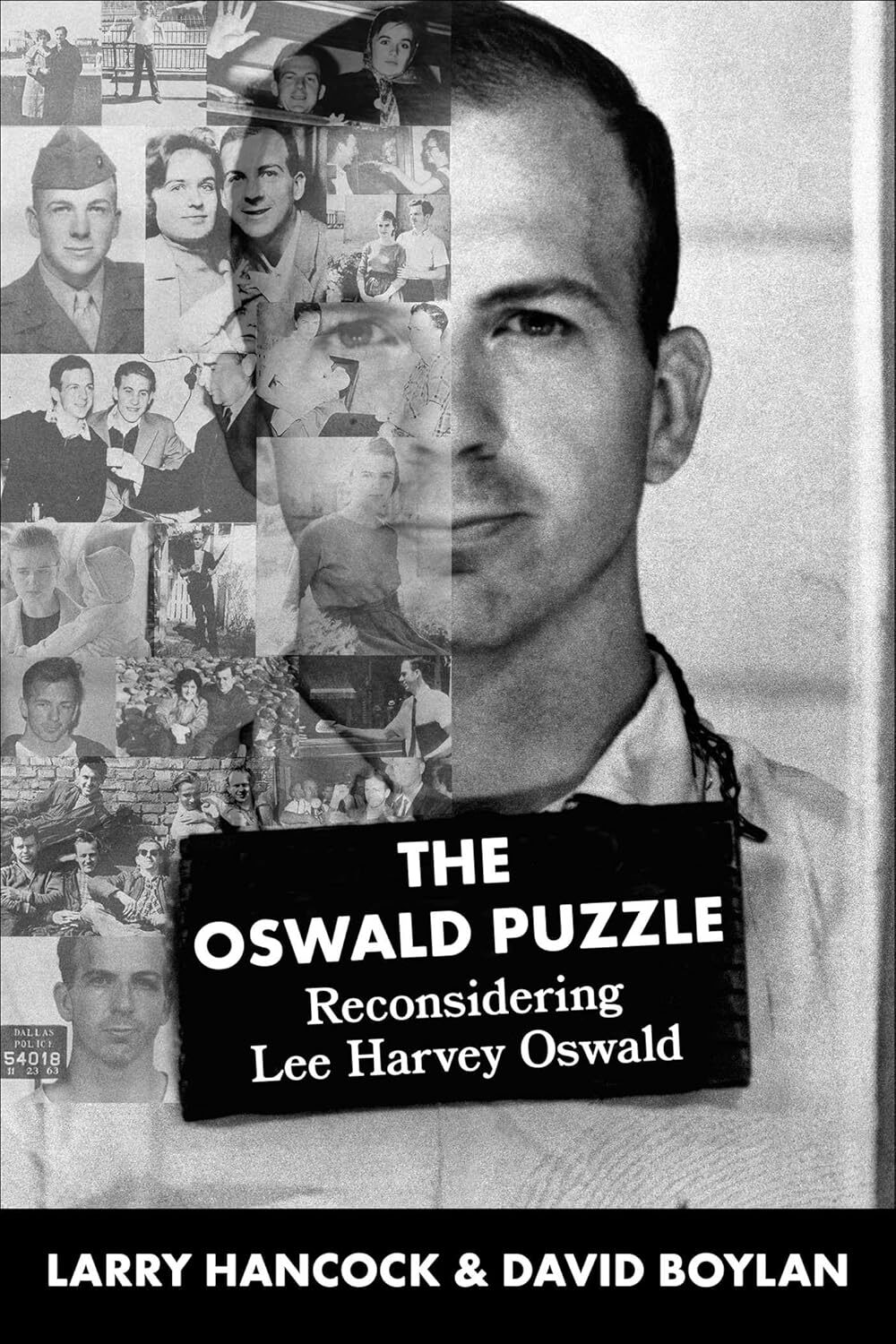
(This is the introduction to Larry Hancock and David Boylan’s new book, “The Oswald Puzzle,” published by Skyhorse Press. It is reprinted with permission of the author.)
 If the Kennedy assassination is a mystery wrapped in a riddle inside an enigma, to quote a famous line from the film “JFK,” then Lee Harvey Oswald is the puzzle at the heart of the mystery. Despite the tracing of the rifle found in the Texas School Book Depository to him, and a whole bullet and two fragments traced to that rifle, the evidence against Oswald has always been thinner than it seems at first glance. Dallas Police Chief Jesse Curry summed it up a few years later: “No one has been able to put him in that building with a gun in his hand.”
Was Oswald framed then, the “patsy” he declared himself to be on national television before Jack Ruby silenced him? Those at the height of government pondered this question. Assistant Attorney General Katzenbach wrote the White House on the day following Oswald’s murder, opening with the statement that “the public must be satisfied that Oswald is the assassin; that he had no confederates who are still at large” but followed with “unfortunately the facts on Oswald seem about too pat – too obvious (Marxist, Cuba, Russian wife, etc.).”
What was “too obvious” was the in-your-face implication that Oswald killed Kennedy at the behest of Fidel Castro or Nikita Khrushchev, and the fear of this “solution” to the crime rocked the government. We now know that the new president, Lyndon Johnson, assembled the Warren Commission by invoking fear of nuclear war. “We’ve got to be taking this out of the arena where they’re testifying that Khrushchev and Castro did this and did that and kicking us into a war that can kill 40 million Americans in an hour,” LBJ told his old Senate mentor Richard Russell, dragging him onto the Commission against Russell’s wishes.
The Warren Commission went on to “solve” the case, declaring Oswald to be the lone assassin of President Kennedy, whistling in the dark past evidence which contradicted its pre-ordained conclusion. This verdict has been hotly contested ever since. Thousands of books have been written on the subject1, and formerly-secret files of the Commission, subsequent investigations, the FBI, the CIA, and other agencies have created a mountainous saga of information — some 5 million pages in the National Archives — without resolution.
Some of the many books on the assassination defend the Warren Commission’s view of Oswald as an unbalanced and dangerous man whose frustrations caused him to murder President Kennedy. Often they go further in this portrayal than the Commission itself, which admitted that it could find not a single instance in which Oswald expressed an unfavorable opinion of Kennedy. The Commission in the end declared that it “does not believe that it can ascribe to him any one motive or group of motives.”
Other books, most of them, challenge the Warren Commission’s findings. Some take on the medical, ballistics, and film evidence regarding whether any one person could have fired all the shots in Dealey Plaza. The infamous “single bullet theory,” whereby one “magic” bullet caused seven wounds in two men (Kennedy and Governor Connally), is so contested, and rightly so, that several books are devoted to it alone. That undamaged and clean bullet, found mysteriously on a stretcher in Parkland Hospital and forensically tied to Oswald’s rifle, has its own 60-year saga – recently added to by Secret Service agent Paul Landis’ 2023 account that no, the bullet wasn’t found on Connally’s stretcher, but rather Kennedy’s, where Landis himself placed it and then didn’t tell anyone. No wonder the American public remains confused.
Many other books on the assassination go straight to the whodunnit — the Mafia did it, or the CIA, or Fidel Castro, or the military, or the right wing. The problem here is that to start with motive, when discussing the assassination of the U.S. president at the height of the Cold War, leads nowhere. Got a group with a motive to kill Kennedy? Get in line.
To the extent Oswald appears in these books at all — and sometimes he is ignored entirely — he is usually a one-dimensional creature. Whether a psychopathic loner, or instead a deep-cover intelligence agent always on assignment, Oswald is too often treated as a cardboard cut-out, moved about in service of a larger narrative. Until this book.

Experts in the ‘Secret War’
I first met Larry Hancock in Dallas more than twenty years ago, while speaking at research conferences that he ran with Debra Conway. Larry gave talks there too, and I was always impressed by his no-nonsense approach and intellectual rigor. I learned from him the invaluable skill of separating the stories of cover-up – for which there are many possible motives, right up to “for the good of the country” I discovered – from the actual crime and conspiracy.
The Mary Ferrell Foundation, which I run, recently published Larry’s “Tipping Point”; that work is in some ways the precursor to the book you hold in your hand. He and his research partner David Boylan are experts on the Kennedy-era “secret war on Cuba” and the many operatives inside and outside the CIA who populate that history. Due to the JFK Records Act, large swaths of files on that subject are now public, available due to the efforts of the Assassination Archives and Research Center which obtained them and the Mary Ferrell Foundation that put them online. In essays and other work over recent years, Larry and David have mined these records to great effect.
But this book is also and primarily about Lee Harvey Oswald, about whom the Warren Commission itself collected and published a great deal of information six decades ago. What new is there to say about him? Plenty, as it turns out. The Commission didn’t have the full story, for one – this book’s contributions to illuminating the formerly-secret and tangled record of Oswald’s trip to Mexico City, from where so many of the allegations of Communist conspiracy emanated, are clarifying and insightful. And recent years have also seen the publication of the important reflections of Oswald’s best friend during his time in Minsk, Ernst Titovets.
“The Oswald Puzzle” is unique, though, in taking head-on the conundrum that has faced so many who have taken the time to understand the details of the Kennedy assassination. If the physical evidence shows that no single person killed Kennedy, then how could someone the Warren Commission went out of its way to portray as a “loner” be responsible at all? And yet Oswald was clearly not just some random person picked up by authorities after the fact. What then, was his role in this affair?
The authors hold no truck with sacred cows. They take the Warren Commission’s own biography of Oswald and strip it of the Commission’s bias, presenting a more nuanced and clear-eyed picture of this unusual young man. But they also take head-on the Walker shooting and the so-called “backyard” photographs of Oswald holding a rifle and pistol, and other stories some pro-conspiracy advocates would prefer to avoid. The result is a fascinating portrait of an unusually fearless and yes, idealistic, individual.
Those unfamiliar with the Oswald biography will encounter a very odd tale; those who think they know the story may be surprised by what they find here. And then, after laying bare the stranger-than-fiction life journey of Lee Harvey Oswald, the authors describe how his pro-Castro activities in New Orleans in the summer of 1963 landed him squarely in the sights of the anti-Castro (and by 1963, anti-Kennedy) exile movement. Hancock and Boylan tell a compelling story of what happened next.
The missing element in our understanding of the Kennedy assassination has always been the lack of a believable counter-narrative to the Warren Report, one which explains who Lee Harvey Oswald really was. Hancock and Boylan have made a profound contribution in this regard. Have they solved the puzzle of Lee Harvey Oswald, and with it some core questions about the conspiracy that took President Kennedy’s life? Read this book and see for yourself.
And if you believe the story told here, then add the tragedy of this young man’s life and his fate to the tragedies of Nov. 22, 1963.