Dr. Josiah “Tink” Thompson is an American writer, retired professional private investigator, and former philosophy professor. In 1967, he published both The Lonely Labyrinth, a study of Kierkegaard‘s pseudonymous works, and Six Seconds in Dallas: A Micro-Study of the Kennedy Assassination. The culmination of his half-century-long Kennedy assassination project was published in early 2021 as Last Second in Dallas.
Thompson graduated from Yale University in 1957 and immediately entered the Navy, serving in Underwater Demolition Team 21. Returning to Yale, Thompson earned his Ph.D. in 1964. He joined the Yale faculty as Instructor in Philosophy and then moved on to teach at Haverford College. Thompson was part of the Haverford philosophy faculty, including a period living and researching in Denmark, until 1976. He wrote or edited several works about Danish philosopher Søren Kierkegaard.
In 1976 Thompson left academia and moved to San Francisco, to begin a new career as a private investigator, first working for Hal Lipset and then David Fechheimer. Thompson worked as a PI for thirty-five years, retiring in 2011. He worked mostly in criminal cases, including the investigation of dozens of murders.
In 1988, Thompson published Gumshoe: Reflections in a Private Eye, a well-received memoir discussing his post-academic life as a private detective.
* * *
Josiah Thompson is back to tell us what really happened to JFK in 1963

Josiah Thompson may have just cracked the John F. Kennedy assassination case.
Fifty-four years after the publication of his 1967 book “Six Seconds in Dallas,” he is back with a follow-up book, “Last Second in Dallas,” that amplifies and revises his findings, using scientific means that weren’t available decades ago.
Thompson, who lives in Bolinas and was a private detective in San Francisco for more than 30 years, is unique among writers in the genre in that he has never advanced a conspiracy theory. He doesn’t know who killed Kennedy in Dallas on Nov. 22, 1963, or why. Instead, Thompson only concerns himself with what can be proved through forensics, photography, ballistics, sound recordings and witness testimony.
His mission, which has lasted from his early 30s through today, at age 86, has been simply to find out what happened as the president’s motorcade passed through Dallas’ Dealey Plaza.
So, what happened?
Seriously. This is my earliest datable memory. I’ve seen Oliver Stone’s “JFK” six or seven times. I’ve wanted to know the answer to this question since I was 4 years old: What happened?
“What happened that day was really simple: It’s what your eyes tell you happened when you see the Zapruder film,” Thompson tells me, referring to the recording of the shooting by Abraham Zapruder on his home-movie camera.
The sequence of events, according to Thompson, is that there were five shots fired, in three bursts. First, Kennedy was shot in the back. Then came the fatal shot from the right front. And finally, less than a second later, Kennedy was shot in the back of the head. Thompson postulates that the shots were fired from three different directions.

In the book, published by the University Press of Kansas, Thompson backs up his findings with analysis of Dictabelt recordings and with full-color, enlarged images taken from the Zapruder film. He puts together and harmonizes seemingly conflicting accounts by people who insist that the shots came from this direction or that. It’s impressive, in that he has his analysis down to the millisecond.
In the process, simply by approaching the question in a different way, Thompson demonstrates what has been the fatal flaw of other books about the assassination, including the granddaddy of them all, the Warren Report, commissioned by President Lyndon B. Johnson in the immediate aftermath of the assassination. They all started with an assumption about what happened and then looked for evidence to support that assumption.
In the case of the Warren Report, the assumption was that Lee Harvey Oswald was the assassin and that he acted alone. In the decades since, many other theories have surfaced — that it was the work of the CIA, or the mafia, or Fidel Castro. But most of the theories did it backward, by devising a scenario and then trying to prove it.
“All the complications come from trying to press this into the wrong profile,” he says.

Thompson’s evidence-based approach is grounded in basic logic. Kennedy’s assassination happened in only one way; therefore, all the evidence should point to the same conclusion. “Events happen in one way rather than another,” Thompson says. “This happened in one way rather than another. And if the event happened one way rather than another, all the evidence should be compatible with all the other evidence.”
There were a series of disappointing TV specials on the 50th anniversary of the assassination in 2013 that treated as canonical the notion that Oswald was the lone assassin. They even suggested that people who believed something different were motivated by emotional need.
“The idea is that Kennedy was such a towering figure that we can’t believe that a lowlife like Oswald could have killed such a figure,” Thompson says. “Talk about amateur psychoanalysis.”
What makes Thompson’s findings a big deal is that, without setting out to do so, he all but proves that there was, indeed, a conspiracy. There had to have been one, by definition, because — according to Thompson — at least three people were involved (unless you believe that three lone assassins woke up that day with the same idea). Thompson further suggests that the very effectiveness of the assassination — it was practically a slaughter — argues in favor of professionals, not amateurs.
“That’s one of the aspects that’s so simple in this case, that’s so f—ing obvious. It worked,” he says. “He’s dead.”
Beyond that, Thompson has no more to add.
“One conspiracy is as good as the others,” he says. “I have nothing intelligent to say, so I shut up about that.”
“Last Second in Dallas”
By Josiah Thompson
(University Press of Kansas; 504 pages; $29.95)
* * *
JFK Conversations: Alan Dale speaks with Dr. Josiah Thompson
Part One
Part Two
Part I – Alan Dale speaks with Dr. Josiah Thompson: distinguished author, investigator and educator. He is a former professor of Philosophy at Yale and Haverford College. In 1966 he wrote an incisive commentary on the work of Richard H. Popkin’s reconstruction of President Kennedy’s assassination published in the New York Review of Books. And in 1967, his landmark work, 6 Seconds In Dallas became one of the decade’s most balanced and influential examinations of the assassination. He is the author of two books on Kierkegaard, and in 1998 he published a memoir of his experience as a private investigator, Gumshoe: Reflections In A Private Eye. He is the subject of a series of interviews — referred to as Op. Docs — conducted by Academy Award winning documentary film maker, Errol Morris, and made available through the New York Times website.
Part II – Alan Dale continues his conversation with Dr. Thompson about the assassination of President Kennedy and the path which leads from 6 Seconds In Dallas (1967) to Thompson’s (at the time of the interview, unpublished) Last Second In Dallas, published 2021.
* * *
* * *
Alan Dale speaks with Dr. Josiah Thompson about Last Second in Dallas. Recorded 16 May, 2021.
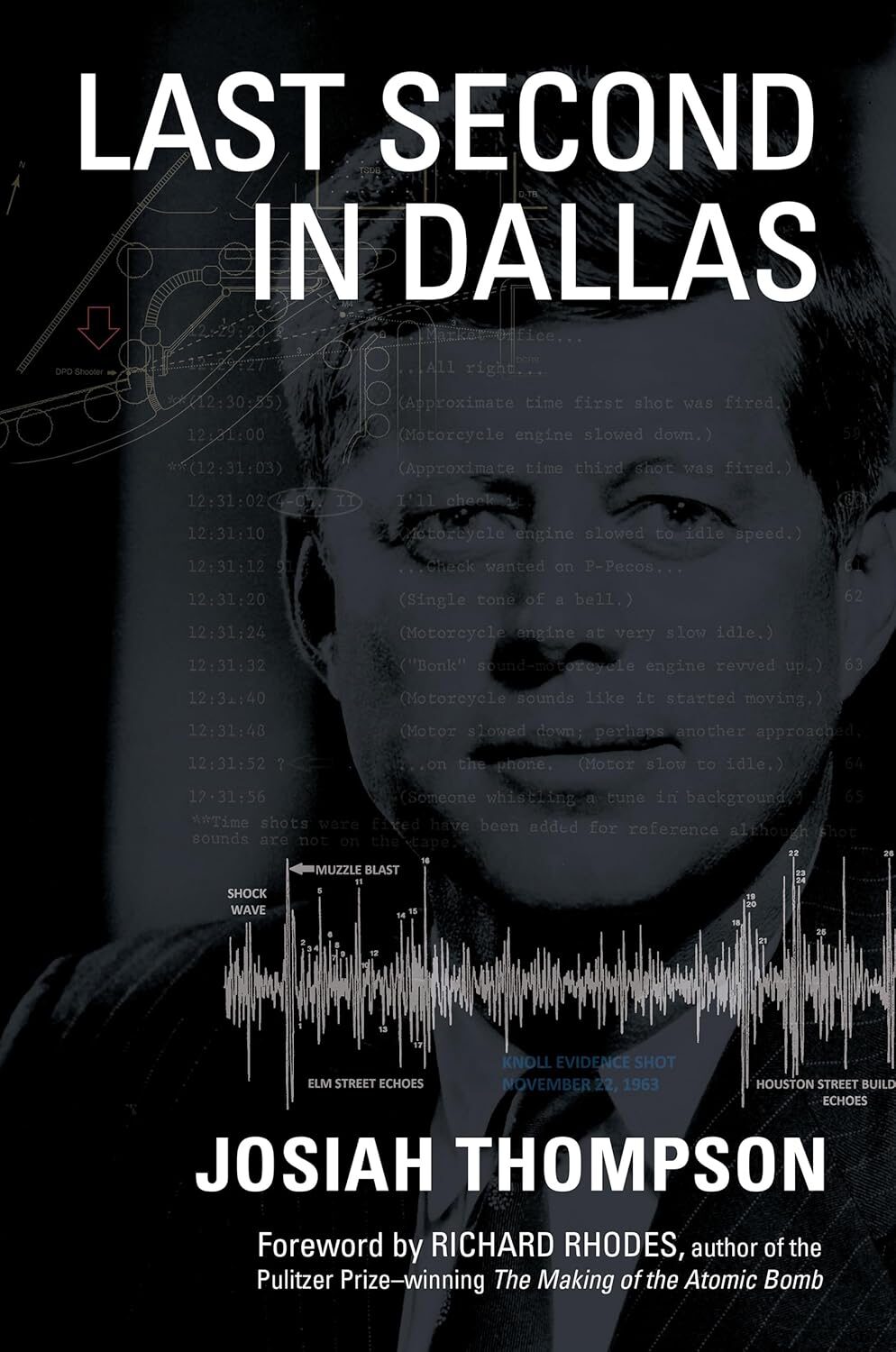 Last Second in Dallas (2021)
More than 50 years after the publication of Six Seconds in Dallas, Dr. Thompson completely revised his work on the Kennedy assassination, including some of his conclusions. Combined with personal memoirs and accounts of his investigation of the evidence, the 475-page illustrated result (361 pages of text, plus appendix, extensive notes and index), Last Second in Dallas, was published by the University Press of Kansas in February 2021.
In 1979, twelve years after publication of Six Seconds in Dallas, Thompson was hired to write part of a new book on the then-just-released House Select Committee on Assassinations (HSCA) Report. His assignment was to evaluate the part of the House Report dealing with the physical facts of what happened in Dealey Plaza. He gave up that project in frustration, the new book explains, when he became convinced that the core evidence in the case, as then understood, was internally contradictory. Confronting an apparent impasse, he turned away from the case and did not return to it until 2011.
During the 32 years since 1979, Thompson recounts in Last Second, the corpus of reliable evidence in the case changed. With respect to the forensic evidence in particular, Thompson claims that advances in scientific research with regard to both acoustics and ballistics removed what had been thought to be major facts from the table of genuine evidence, by showing them to be mistaken.[21]
Thompson relies not only on the Zapruder film and the police radio dictabelt recording of the shooting (which he defends as valid), but also begins the book by quoting the reports of numerous witnesses he interviewed for LIFE magazine in 1966 and 1967. In the end, Thompson writes, he concluded that the cleansed forensic arguments confirm what numerous eye-witnesses reported just after the shooting in November 1963, that is, that Kennedy had been shot from the front as well as from behind.
Throughout the book, Thompson emphasizes and scrutinizes the raw facts of the case. Thompson argues from close examination of the Zapruder film that the last two shots can be seen hitting their target, and contends that these impacts match exactly the timing of shots heard on the dictabelt recording. When first struck in the head at Zapruder frame 313, almost five seconds after the initial burst of gunfire which had already wounded Kennedy and Texas Governor Connally, the President moves backwards and to the left. Riding to the limousine’s left rear are two Dallas Police motorcycle outriders who experience brain and blood debris blown over them at high velocity. Thompson claims that less than a second later at frame 328, Kennedy is hit in the head a second time, from the rear, and his body and head are then catapulted directly forward, with blood and brain blasted as far forward as the car’s hood ornament.
In Last Second, as in Six Seconds some 54 years earlier, Thompson eschews all speculation as to who the conspirators may have been as well as their motives. Focusing on the final second of the assassination, he contends that Kennedy was hit twice in the head, just 0.71 seconds apart, by bullets fired from diametrically opposed directions. The first of these final and equally non-survivable shots, Thompson argues, came from behind a stockade fence atop the grassy knoll and not from the Texas School Book Depository, where Lee Harvey Oswald was allegedly located.
* * *
The Umbrella Man
A Film By Errol Morris
In 2011, The New York Times posted a short documentary film by Errol Morris featuring Thompson’s commentary about the “Umbrella Man“, a man holding a black umbrella during the assassination of Kennedy. In this interview, Thompson deploys both his philosophical and his criminal investigative skills to elucidate the difference between logical inferences premised on facts and speculative conspiratorial theorizing.
* * *
Last Second in Dallas: A Granular Account of the Final Second of the Assassination
Courtesy of the The Sixth Floor Museum at Dealey Plaza; Recorded 18 November, 2022: In this special 90-minute program, first-generation Kennedy assassination researcher Josiah Thompson discusses his decades-long involvement with the case and the making of his critically acclaimed 1967 classic, Six Seconds in Dallas. Thompson then brings his research full circle with a presentation based on his 2021 book, Last Second in Dallas.
* * *
INTERVIEW WITH JOSIAH THOMPSON (DECEMBER 29, 1967)
Courtesy of David Von Pein’s JFK Channel: From Pacifica Radio, Dr. Josiah Thompson speaks with William O’Connell about Six Seconds in Dallas.